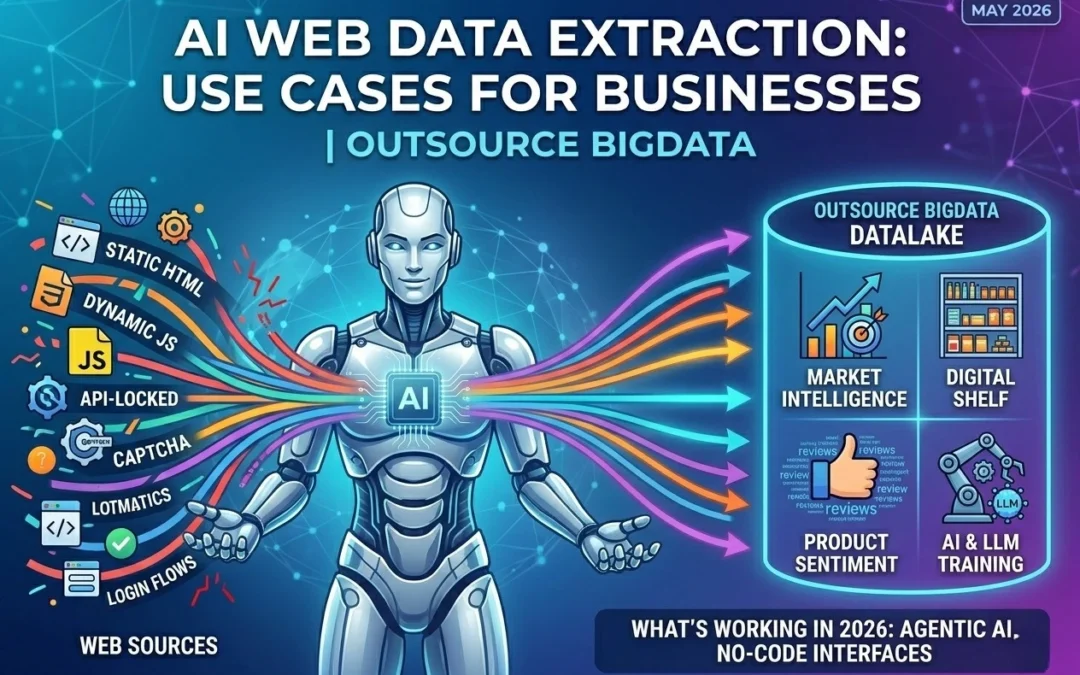
How AI Data Extraction Works ? | Outsource Bigdata
Author : Jyothish
How AI Data Extraction Works? | Outsourcebigdata
Author : Jyothish
AIMLEAP Automation Works Startups | Digital | Innovation | Transformation
Table of Contents
2. Why AI Data Extraction Is Different from Traditional Scraping
3. Traditional Scraping:what Breaks and Why?
4. How AI Overcomes These Limitations?
5. Traditional Scraping vs. AI-Powered Extraction: Side-by-Side Comparison
6. The Core AI Technologies Powering Data Extraction in 2026
7. Computer Vision for Visual Layout Understanding
8. Real-World Use Cases: Where AI Data Extraction Delivers ROI
9. How to Choose the Right AI Data Extraction Tool or Service
11. FAQs
Introduction
Your competitor updates pricing 12 times a day. Their product pages refresh every few hours, reflecting flash deals, inventory shifts, and regional discounts. If you are still running a weekend manual check or a brittle rule-based scraper from two years ago, you are already losing ground. This is the reality for thousands of businesses right now, and AI data extraction is the solution they are turning to.
AI data extraction is the use of machine learning, natural language processing, and computer vision to automatically pull structured information from websites at scale. Unlike traditional scraping that relied on fragile CSS selectors or regular expressions, AI-powered systems understand context, adapt to layout changes, and make sense of unstructured content the same way a trained analyst would, only thousands of times faster.
What is AI data extraction?
AI data extraction is the automated process of using machine learning and NLP to identify, collect, and structure data from websites without hardcoded rules. Unlike traditional scrapers, AI systems understand page context, handle JavaScript rendering, and self-heal when website layouts change.
Why AI Data Extraction Is Different from Traditional Scraping?
scraping in its original form meant writing rules. A developer would inspect a page, locate the CSS class or XPath of the element they needed, and hardcode instructions to grab it. It worked well for stable pages with predictable layouts. The problem is the has never been stable, and it is becoming less so every year.
AI data extraction takes a fundamentally different approach. Instead of telling the system exactly where to look, you describe what you want, and the system figures out where to find it. Trained models recognise patterns across thousands of page structures, understand semantic meaning from raw text, and build flexible parsers that do not fall apart when a developer renames a div class.
Traditional Scraping: What Breaks and Why?
Rule-based scrapers are brittle by design. Here is what causes failures most often:
1. Site redesigns:
When a page layout changes, even slightly, XPaths and CSS selectors point to nothing or return wrong data.
2. JavaScript rendering:
Frameworks like React, Angular, and Vue load content dynamically. A basic HTTP request returns an empty shell, not the actual data.
3.Constant maintenance:
Every site update demands a human patch. For teams monitoring hundreds of domains, this becomes a full-time job that generates zero business value.
4.Scale limitations:
Manually writing and maintaining rules for thousands of URLs simply does not work at enterprise scale.
How AI Overcomes These Limitations?
AI-powered extraction systems learn what a price looks like, not just where it sits on a specific page. They use context, surrounding text, typography, and layout signals to identify data fields regardless of where they appear in the DOM. Key advantages include:
1. Pattern learning:
Models trained across millions of pages recognise data types by their semantic meaning, not their HTML address.
2. Self-healing selectors:
When a reliable extraction path stops working, the system detects the anomaly and searches for the element in its new location automatically.
3. Zero-shot generalisation:
A 2026 benchmark study found that LLMs can hit F1 extraction accuracy scores above 0.95 on well-formatted structured pages, with no prior training on that specific site.
4. JavaScript handling:
Headless browser automation renders dynamic content fully before parsing begins, treating React and Angular pages the same as static HTML.
Traditional Scraping vs. AI-Powered Extraction: Side-by-Side Comparison
| Criteria | Traditional Scraping | AI-Powered Extraction |
| Selector type | CSS / XPath rules | ML-based pattern detection |
| When site changes | Breaks immediately | Self-heals automatically |
| JavaScript pages | Fails without extra setup | Handles natively |
| Unstructured text | Cannot parse meaning | NLP extracts context |
| New site, no training | Requires manual re-coding | Zero-shot generalisation |
| Setup time | High (write rules for each site) | Low (learns from examples) |
| Ongoing maintenance | Constant manual patches | Minimal, automated |
| Accuracy at scale | Degrades as sites evolve | Consistent over time |
The Core AI Technologies Powering Data Extraction in 2026
This is where most guides stay surface-level. Understanding the actual technology stack helps you evaluate tools, set realistic expectations, and build extraction strategies that hold up under real-world conditions. Four technologies do the heavy lifting in every modern extraction pipeline.
Natural Language Processing (NLP) for Unstructured Content
Most of the is text, and most of that text is unstructured. NLP gives extraction systems the ability to read it meaningfully. Key NLP capabilities in an extraction context include:
1. Named Entity Recognition (NER):
Automatically identifies people, companies, locations, dates, and product names within raw text blocks without any field-level rules.
2. Sentiment analysis:
Classifies product reviews, news mentions, and customer feedback as positive, negative, or neutral with context-aware accuracy.
3.Topic classification:
Groups articles, listings, and posts by subject matter without requiring predefined labels or manual tagging.
4. Intent extraction:
Identifies what a text block is communicating, whether it is a price announcement, a policy change, or a hiring signal.
When Outsourcebigdata extracts competitive intelligence from industry news sites for clients, NLP is what transforms thousands of raw articles into clean, categorised datasets that analysts can work with immediately.
Computer Vision for Visual Layout Understanding
Not everything can be understood from the DOM tree alone. Computer vision gives extraction systems the ability to see a page visually, the same way a human looking at a browser window would. This is critical for:
1. PDF documents:
Extracting data from tables, invoices, and reports that are image-based or scanned rather than text-based HTML.
2. Image-based product listings:
Reading prices, SKUs, or labels from product images where the data never appears as selectable text.
3. Complex table structures:
Identifying column boundaries and relationships in visual tables that DOM parsing gets wrong.
4. Honeypot resistance:
Vision-language models (VLMs) that see pages visually are more resilient to CSS-class randomisation and anti-bot traps than DOM-dependent approaches.
In 2026, tools using VLM-based extraction now perform zero-shot identification of page elements based on visual intent rather than code patterns, making them significantly harder to break through routine site updates.
Large Language Models (LLMs) as Extraction Engines
LLMs have changed what is possible in data extraction. The key capabilities they bring to a pipeline include:
1. Prompt-based extraction:
Describe in plain language what you want to extract and the model figures out where it is, even on pages it has never seen before.
2. Ambiguity resolution:
Where a product title and a category breadcrumb use similar language, an LLM understands which is which from context.
3. Unstructured-to-structured:
Convert raw paragraphs from news articles or earnings reports into structured data fields without pre-built templates.
4. Efficient at small scale:
A February 2026 paper from Cairo University showed that a 0.6B parameter model paired with intelligent DOM pruning can achieve F1 scores of 88.1% while cutting input token use by 97.9%, meaning LLM-powered extraction is no longer prohibitively expensive for high-volume work.
Well-designed pipelines use LLMs selectively, applying them to ambiguous or novel pages and routing routine extractions through faster, lighter models to control cost and latency.
Self-Healing Selectors and Adaptive Parsing
Self-healing is not a marketing term. It refers to a specific set of technical mechanisms that keep extraction pipelines running through site changes:
1. Change detection:
Continuous monitoring compares current extraction output against expected patterns. Empty fields or format mismatches trigger alerts immediately.
2. Automated re-learning:
When a field is missing, the system runs alternative extraction strategies and promotes the one returning valid output.
3. A/B strategy comparison:
Multiple parsing approaches run in parallel and results are scored against quality criteria, with the winner automatically promoted.
4. Version tracking:
Site structure snapshots allow the system to diff page versions and identify where specific elements have moved.
At Outsourcebigdata, adaptive parsing is a core part of managed extraction services for e-commerce and financial data clients, ensuring pipelines keep running even when target sites update overnight without any manual intervention.
Step-by-Step: How an AI Extraction Pipeline Actually Works
Understanding the stages of a real pipeline helps you ask the right questions when evaluating tools and anticipate where problems occur. Here is what happens between providing a target URL and receiving clean, structured data.
| # | Stage | What Happens |
| Step 1 | URL Discovery | Crawl scheduler maps all target pages, prioritises by change frequency |
| Step 2 | JS Rendering | Headless browser loads the full page including dynamic content |
| Step 3 | AI Parsing | ML model identifies and maps fields to your data schema |
| Step 4 | Cleaning | Normalise formats, strip junk, deduplicate near-identical records |
| Step 5 | Delivery | Push data to API, webhook, or data warehouse on your schedule |
Step 1: URL Discovery and Crawl Scheduling
Everything starts with knowing where to look. A production-grade crawl layer handles:
1. Sitemap parsing:
Reads XML sitemaps to discover all indexable pages on a domain quickly without brute-force crawling.
2. Link graph traversal:
Follows internal links to discover pages not in sitemaps, including dynamically generated listing pages.
3. Priority scheduling:
High-change-frequency pages (product prices, news articles) are crawled more often than static content like About pages.
4. Rate control:
Crawl rates are throttled to stay within polite limits and avoid triggering anti-bot measures or server strain.
Step 2: JavaScript Rendering and Browser Automation
Headless browsers (Puppeteer, Playwright) handle the JavaScript rendering problem. The crawl layer:
1. Spins up a browser instance and loads the full page including all dynamic content
2. Waits for network requests to settle before passing the DOM to the parsing layer
3. Handles scroll-to-load, click-to-expand, and pagination interactions automatically
4. Manages sessions, cookies, and user-agent rotation to maintain crawl continuity
Step 3: AI Parsing and Field Identification
With a fully rendered page available, the AI parsing layer:
1. Applies trained extraction models to identify which elements correspond to requested data fields
2. Uses LLM reasoning for ambiguous content where rule-based models are uncertain
3. Maps raw page elements to a structured schema: product name, price, availability, author, date, and so on
4. Assigns confidence scores to each extracted field so low-confidence values can be flagged for review
Step 4: Data Cleaning, Normalisation and Deduplication
Raw extracted values are almost never ready for analysis immediately. The cleaning layer handles:
1. Format standardisation: Prices stripped of currency symbols, dates converted to ISO format, phone numbers normalised.
2. Unit conversion: Weights, dimensions, and currencies unified to a single standard across sources.
3. Deduplication: Fuzzy matching algorithms identify near-duplicate records from paginated listings or multiple crawl runs.
4. Completeness checks: Fields required by the output schema are validated and missing values flagged for follow-up.
Step 5: Output Delivery (API, Webhook, Warehouse)
Once data is clean and structured, delivery options include:
1. REST API:
Query the latest data on demand with filtering and pagination built in.
2. Webhooks:
New records pushed to your systems the moment they are available, enabling real-time workflows.
3. Data warehouse integration:
Direct delivery to Snowflake, BigQuery, or Redshift in the schema your BI tools expect.
4. Flat file export:
CSV, JSON, or XML for teams that need to work with data in spreadsheets or legacy systems.
Outsourcebigdata supports all four delivery modes and builds output schemas to match exactly what your downstream systems expect, so there is no manual reformatting step on your end.
Real-World Use Cases: Where AI Data Extraction Delivers ROI
1. E-Commerce Price Intelligence
A mid-size online electronics retailer was losing margin on high-velocity SKUs because competitors repriced multiple times daily while the team only reviewed competitive data weekly. After implementing an automated AI extraction setup monitoring 18 competitor sites in real time:
1. Repricing lag dropped from 7 days to under 2 hours
2. Gross margin on affected categories improved by 4.2 percentage points within one quarter
3. Out-of-stock signals from competitors were captured automatically, triggering promotional opportunities
4. The pipeline fed directly into their dynamic pricing engine with no manual handoff
2. B2B Lead Generation and Market Research
A data provider needed a database of 40,000 manufacturing companies with specific firmographic details: revenue band, employee count, product categories, and decision-maker contact information. Manual research would have taken months. An AI extraction pipeline covering industry directories, company websites, and trade publications delivered:
1. 40,000 structured records in under two weeks
2. NLP-powered company classification into 12 product categories with over 94% accuracy
3. Contact fields extracted and validated against format rules automatically
4. Equivalent manual effort estimated at 10 researchers working full-time for 8 weeks
3. Financial Data and Brand Monitoring
Investor relations teams and equity analysts rely on extraction pipelines to track earnings announcement language, SEC filing structures, and sentiment trends in financial media. Key outcomes from real deployments include:
1. Real-time alerting when specific companies are mentioned in regulatory filings
2. Sentiment scoring on thousands of news articles per day with context-aware accuracy
3. Demand forecasting accuracy improvements of up to 23% when structured data is fed into forecasting models (per published 2026 case data)
4. Stockout rate reductions of 35% for retail clients using AI-extracted competitive inventory signals
5. Is AI Data Extraction Legal and Ethical?
Is scraping legal in 2026?
scraping publicly accessible data is generally legal in most jurisdictions, as confirmed by the hiQ vs. LinkedIn ruling. However, legality depends on what data is collected, how robots.txt and Terms of Service are handled, and whether personal data protections like GDPR apply. Always review ToS and consult legal counsel for commercial use cases.
This is the most-asked question in the space, and the honest answer is: it depends on specifics. There is no blanket law that prohibits scraping, but several frameworks define acceptable practice.
1. robots.txt and Terms of Service
1. robots.txt: Not legally binding in most jurisdictions, but ignoring it entirely exposes you to ToS violations, IP bans, and potential litigation. A responsible extraction operation always reviews and respects it.
2. Terms of Service: The hiQ Labs vs. LinkedIn case in the United States established that scraping publicly accessible data does not automatically violate the Computer Fraud and Abuse Act. However, commercial ToS violations can still result in civil claims.
3. Authenticated content: Extracting data that sits behind a login without explicit permission is legally and ethically distinct from scraping public pages and should always be avoided.
2. GDPR and Data Privacy
1. Personal data: If your extraction pipeline collects information about EU residents, you need a lawful basis for processing it under GDPR.
2. PII handling: Strip personally identifiable information unless it is genuinely required for your stated business purpose.
3. Jurisdiction tracking: In 2026, AI compliance tools are emerging to help organisations audit data sources and maintain compliance across multiple legal frameworks simultaneously.
Best Practices Checklist for Legal and Ethical Extraction
1. Review robots.txt before crawling any domain
2. Read and comply with site Terms of Service for commercial use
3. Never scrape content behind authentication without written permission
4. Throttle request rates to avoid server strain
5. Strip PII from extracted datasets unless explicitly required
6. Document your legal basis before launching any commercial pipeline
At Outsourcebigdata, every client project goes through a compliance review before extraction begins. This is not a box-ticking exercise. It is a practical check that keeps client data pipelines running without legal disruption.
How to Choose the Right AI Data Extraction Tool or Service?
The market for extraction platforms has matured rapidly. Choosing well comes down to matching the tool to your specific use case rather than chasing the longest feature list. Evaluate on these criteria:
1. Extraction accuracy:
Ask for sample data runs against your actual target sites. Field-level precision above 97% is achievable with well-built pipelines. Anything below 90% will create downstream data quality problems.
2. JavaScript handling:
Confirm how the tool handles React, Angular, and Vue pages. Headless browser support is non-negotiable for most commercial data use cases in 2026.
3. Self-healing capability:
Request evidence of how the system handles site changes. How quickly does it recover? Does it require manual intervention? How are clients notified?
4. Scalability:
Some platforms handle thousands of pages per day but struggle at millions. Test under realistic load before committing, particularly if your data needs are growing.
5. Output format flexibility:
Your data warehouse, BI tool, and CRM all have different format requirements. A good extraction service builds the output schema to match your systems exactly.
6. Compliance support:
For regulated industries or EU data, look for providers who include compliance review as a standard part of the engagement, not an add-on.
7. Pricing transparency:
Understand whether pricing is per-record, per-site, or subscription-based. Factor in the cost of maintenance and break-fix support when comparing in-house builds to managed services.
Why Businesses Choose Managed Extraction Over In-House Builds
Building from scratch requires engineering time for browser automation, model integration, cleaning pipelines, and monitoring. The real cost becomes visible only after launch, when ongoing maintenance, site-change incidents, and scaling work add up.
Outsourcebigdata offers managed extraction as a fixed-scope engagement with per-record or subscription pricing covering infrastructure, maintenance, compliance review, and output delivery. For most teams, this proves more cost-effective than internal builds once the full maintenance burden is factored in.
Conclusion and Next Steps
AI data extraction has moved well past the experimental stage. In 2026, it is practical, cost-effective infrastructure for businesses that need market data, competitive intelligence, or research at scale. Three things are worth taking away from this guide:
1. The technology has matured to the point where accuracy and reliability are no longer the main barriers. Choosing the right approach for your data volume and use case is now the primary challenge.
2. Legal and ethical compliance is manageable with the right processes in place. It should not be a reason to avoid the technology, but it does require deliberate attention before you launch a commercial pipeline.
3. The combination of LLMs, vision models, and self-healing systems means that data you previously considered too complex or too dynamic to collect automatically is now well within reach at a cost that makes sense for most businesses.
Ready to See What AI Extraction Can Do for Your Business?
The team at Outsourcebigdata works with e-commerce brands, financial services firms, market research agencies, and growth teams who need accurate, timely data without the engineering overhead of building and maintaining pipelines themselves.
We offer a free sample data run against your target sites so you can see field-level accuracy and output schema quality before making any commitment. Reach out to the Outsourcebigdata team to get started.
FAQs
Questions sourced from Google People Also Ask, Reddit r/datascience, and r/scraping for the search intent ‘how AI data extraction works’.
Is scraping the same as AI data extraction?
Not exactly. scraping is the broad category covering any automated method of pulling data from websites. AI data extraction is a specific approach within that category, using machine learning and language models to understand content contextually rather than following fixed rules. For simple, stable pages, traditional scraping still works fine. For complex, changing, or unstructured content at scale, AI extraction is the practical choice.
Can AI extract data from JavaScript-heavy websites?
Yes. Modern AI extraction pipelines use headless browsers to fully render JavaScript before parsing begins. Frameworks like React, Angular, and Vue that load content dynamically are handled as a matter of course. The browser automation layer waits for the page to stabilise before passing the rendered DOM to the extraction model, so the AI sees exactly what a human would see in a browser.
How accurate is AI data extraction compared to manual data entry?
For well-structured pages, field-level accuracy routinely exceeds 97 to 99 percent, which is comparable to careful human data entry and far faster. For unstructured or visually complex pages, accuracy depends on model training quality and the post-processing pipeline. At Outsourcebigdata, extraction accuracy is validated against spot-checked samples as part of every managed service contract, with high-variance fields flagged for human review.
What types of data can AI extract from websites?
Almost anything visible on a rendered page: product names, prices, descriptions, reviews, ratings, contact details, job postings, news articles, financial figures, event listings, and social media posts. Computer vision extends this to data embedded in images and PDFs. The practical limiting factors are authentication requirements and legal restrictions, not technical capability.
How do self-healing selectors actually work?
Self-healing systems monitor extraction output continuously against expected patterns. When a price field returns empty or a date field starts returning non-date text, the anomaly is detected automatically. The system runs alternative extraction strategies, scores them against quality criteria, and promotes the best-performing approach. Most production platforms resolve site changes within one to two crawl cycles with no manual work required.
Is it expensive to get started with AI data extraction?
The cost depends on volume, complexity, and whether you build in-house or use a managed service. Building from scratch requires significant engineering investment upfront plus ongoing maintenance. Managed services like Outsourcebigdata offer per-record or subscription pricing that covers infrastructure, maintenance, and compliance review, which is often more cost-effective than internal builds once ongoing maintenance overhead is factored in. Many providers offer sample data runs at no cost so you can validate quality before committing.
Get Notified !
Receive email each time we publish something new: