What Is an AI Scraping API?
What Is an AI Scraping API?
AIMLEAP Automation Works Startups | Digital | Innovation | Transformation
Table of Contents
- What Exactly Does a Scraping API Do?
- Where Does the AI Part Actually Come In?
- How Does an AI Scraping API Work, Step by Step?
- Building Your Own Scraper vs. Using an API: When Does Each One Make Sense?
- What Can You Actually Do With One? Real Use Cases by Industry
- Is Scraping Legal, and What Do You Need to Watch Out For?
- What Should You Look for When Choosing a Scraping API?
- Which AI Scraping APIs Do Developers Actually Use in 2026?
- Frequently Asked Questions
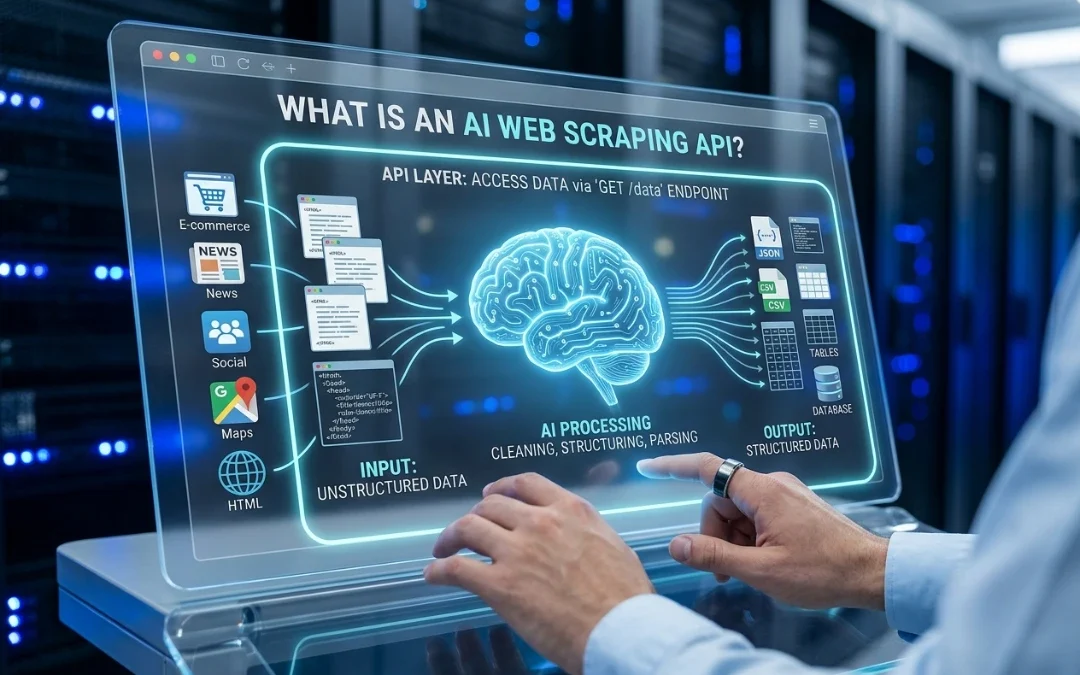
An AI scraping API is a service that lets you send a website URL and get back clean, structured data in return. It handles all the hard parts for you: running a real browser to load JavaScript, rotating IP addresses to avoid blocks, solving CAPTCHAs automatically, and using machine learning to pull out exactly the fields you need. Instead of weeks of infrastructure work, you write a few lines of code.
Every day, billions of data points sit on public websites: product prices, job listings, contact details, news articles, market trends. That data is valuable. The problem is getting to it reliably, without your code breaking every time a website updates its layout or adds a new anti-bot measure.
For years, developers handled this by writing scrapers from scratch. They used libraries like BeautifulSoup or Scrapy, maintained proxy lists, and spent weekends fixing broken CSS selectors. It worked, but it was exhausting. Then came a better option.
At Outsourcebigdata, we work with data teams across industries who need structured data at scale. The shift we have watched happen over the past few years is clear: teams that used to spend 60% of their time maintaining scrapers now spend that time using the data they collect. The tool making that possible is the AI scraping API.
What Exactly Does a Scraping API Do?
A scraping API is a programmatic service that extracts data from websites for you. You send it a URL. It comes back with the data from that page, usually in a clean format like JSON. What sits between those two steps is the entire complexity of modern scraping: browser automation, IP management, CAPTCHA solving, HTML parsing, and data structuring.
Think of it like outsourcing the infrastructure. You do not need a proxy pool, a headless browser setup, or a dedicated server. The API provider manages all of that. Your job is simply to ask for data and use what comes back.
Here is what a basic API call typically looks like in Python:
import requests
response = requests.get(
‘https://api.example-scraper.com/extract‘,
params={‘url‘: ‘https://target-site.com/products‘, ‘api_key‘: ‘YOUR_KEY’}
)
data = response.json()
print(data) # {‘title’: ‘Blue Sneakers’, ‘price’: ‘$49.99’, ‘rating’: ‘4.5’}
That is the whole interaction from your side. Behind the scenes, the API has loaded the page in a real Chrome browser, bypassed any bot detection, parsed the HTML, and returned structured data. The complexity is completely hidden from you.
What a scraping API returns: Most modern APIs return data in JSON format. Some return raw HTML, plain text for LLM processing, or markdown. The best providers let you specify which fields you want extracted using natural language, and they return those exact fields with no extra noise.
Where Does the AI Part Actually Come In?
This is the most misunderstood part of the whole category. When people hear ‘AI scraping API’, they often picture something futuristic. In practice, AI shows up in two very specific and useful ways, and understanding both helps you make better decisions about which tool to use.
The first way is infrastructure intelligence. This is AI working quietly in the background to handle problems that break traditional scrapers. Things like:
- Detecting that a page is using a new anti-bot system and adjusting the request headers automatically
- Recognizing that a product page has changed its layout and re-mapping the data fields without you having to rewrite your code
- Solving CAPTCHAs in real time, including the behavioral ones that track mouse movement and scroll patterns
- Rotating proxies intelligently based on whether the previous request succeeded or failed
The second way is extraction intelligence. This is where large language models (LLMs) come in directly. Instead of telling a scraper ‘extract the text inside the div with class price_wrapper’, you now write: ‘extract the product name, price, and availability’. The model reads the page, understands its structure, and pulls out what you asked for. It works on pages it has never seen before.
According to a 2026 benchmark published in Medium, product queries run against structured JSON extracted by LLM-powered scrapers returned 94% factually accurate results. The same queries run against raw markdown output returned 71% accuracy. That 23-point gap is not a small difference: it is the gap between a chatbot giving you correct prices and one that hallucinates.
What Role Does a Website’s Terms of Service Actually Play?
Many people assume that if a website’s Terms of Service say “no scraping”, then scraping is illegal. This is a common and understandable misconception, but the law is more nuanced than that.
A Terms of Service agreement is a contract, not a law. Whether that contract is enforceable against you depends on whether you actually agreed to it. Courts distinguish between two types of ToS agreements: browsewrap agreements, where terms are buried in a footer link that you never explicitly clicked, and clickwrap agreements, where you actively ticked a box or clicked a button saying you agreed. Courts have generally been reluctant to hold scrapers to browsewrap terms, particularly for publicly visible data. But if you created an account and agreed to the ToS during that process, those terms become a binding contract. Violating them exposes you to civil claims for breach of contract, even if it does not trigger the CFAA.
The practical risks of a ToS violation short of a court case are also real. Platforms actively monitor for scraping patterns and respond with IP bans, legal notices, and cease-and-desist letters. For companies like Outsourcebigdata that run data extraction projects at scale, respecting ToS and rate-limiting requests is not just a legal consideration, it is operational good practice. A scraper that triggers a platform’s defences is a scraper that stops delivering data.
How Traditional Scrapers Handle Page Changes vs. How AI-Powered Ones Do It Differently
A traditional scraper uses CSS selectors or XPath expressions. You write something like: find the element with class ‘product-price’ and extract its text. This works perfectly until the website renames that class to ‘item-cost’. Then your scraper silently returns nothing or crashes. This is not a theoretical problem. In practice, teams maintaining traditional scrapers at scale spend 40 to 60 percent of their time in break-fix mode, according to research from Scrap.io.
An AI-powered scraper does not look for ‘product-price’. It looks for content that looks like a price. A number with a currency symbol, near other product information. When the HTML changes, the extraction logic does not break because it never depended on the HTML structure to begin with.
Key difference: Traditional scrapers are tied to the shape of a page. AI-powered scrapers are tied to the meaning of the content. That distinction alone is why maintenance costs drop so sharply once teams move to an AI-based approach.
How Does an AI Scraping API Work, Step by Step?
The full pipeline is more involved than most introductions let on. Here is what actually happens between the moment you send a URL and the moment clean data lands in your application.
- Step 1: Request received. You send the target URL to the API endpoint, along with any extraction parameters (which fields you want, what format, any login credentials if needed).
- Step 2: Browser launch. The API spins up a headless Chrome or Chromium browser instance. This is a full browser engine, not just an HTTP request. It executes JavaScript, loads external resources, and renders the page exactly as a human would see it.
- Step 3: Anti-bot handling. Before the page even loads, the API configures the browser with a realistic fingerprint: the right TLS signature, real-looking HTTP headers, a residential IP address. If the page serves a Cloudflare challenge, a DataDome check, or a CAPTCHA, the API handles it.
- Step 4: Page interaction. For complex pages, the API may scroll to trigger lazy-loaded content, click through pagination, or wait for specific elements to appear before extracting.
- Step 5: Content extraction. The rendered HTML is passed to the extraction layer. Depending on the tool, this uses pre-trained models for known page types (product pages, news articles, job listings), LLM prompting for custom extraction, or CSS/XPath templates for precise control.
- Step 6: Data returned. Clean JSON, markdown, or structured text comes back to your application. No HTML noise, no raw markup to parse yourself.
What Happens When a Site Blocks Automated Requests?
Blocking is the primary reason people pay for an API instead of running their own scraper. Modern anti-bot systems are sophisticated. Cloudflare, DataDome, Akamai, and PerimeterX do not just check whether your request came from a known data center IP. They analyze TLS fingerprints, browser behavior, timing patterns, and behavioral signals across thousands of requests.
Good scraping APIs handle this through a combination of residential proxies (real IPs from real internet service providers), browser fingerprint spoofing, and challenge-solving infrastructure. When a block happens, the API retries with a different approach automatically. You never see the failure.
At Outsourcebigdata, we have seen clients attempt to build this infrastructure themselves. The typical result is three to four months of engineering time, ongoing maintenance, and success rates that still fall below 90% on heavily protected sites. A quality scraping API achieves 95%+ success rates on the same sites out of the box.
Building Your Own Scraper vs. Using an API: When Does Each One Make Sense?
This is a genuine trade-off, not a clear-cut answer. Both approaches have legitimate use cases, and the right choice depends on your volume, technical resources, and how much you value speed to data over long-term cost efficiency.
Build your own scraper when:
- You are scraping static HTML pages with structures that rarely change
- Your volume is very high (millions of requests per month) and per-request API costs exceed infrastructure costs
- You need to scrape internal networks or non-public sites that external APIs cannot reach
- You have specific compliance requirements around where your data gets processed
Use a scraping API when:
- Your target sites use JavaScript rendering (React, Vue, Angular) and simple HTTP requests return empty HTML
- You need to bypass anti-bot protection and do not have the time or team to maintain that infrastructure
- You need to move fast: days, not months, to a working data pipeline
- Your scraping volume is in the 10,000 to 500,000 requests per month range
- You want the data team focused on using data, not maintaining the collection system
What Is the Real Cost Comparison Over 12 Months?
Most teams only measure the API’s per-request cost. That is the wrong number to optimize. The full picture includes four additional costs that are often larger: the engineering time maintaining scrapers that break, the LLM token cost of processing noisy data, the accuracy cost of bad data producing wrong outputs, and the opportunity cost of debugging instead of building.
The break-even point for most teams sits around 10,000 to 50,000 requests per month. Below that, an API almost always wins. Above it, the math depends on your page complexity. One 2026 analysis showed that a tiered pricing API charged $15 for the same 100-page crawl that cost $79 on a flat-rate plan, because the tiered API only charged premium rates for the pages that actually needed advanced anti-bot bypass. At scale, that difference is tens of thousands of dollars annually.
What Can You Actually Do With One? Real Use Cases by Industry
The applications for AI scraping APIs span virtually every industry that depends on timely, external data. Here are the most common and most valuable use cases we see at Outsourcebigdata.
- E-commerce price monitoring: Track competitor pricing across Amazon, eBay, Shopify stores, and brand websites in real time. Retailers running ML-powered price extraction across millions of product pages daily are not just copying prices, they understand context: whether a competitor’s discount is margin-funded or promotion-driven.
- Lead generation: Extract business names, verified emails, phone numbers, and social profiles from directories, LinkedIn, and Google Maps at scale. One marketing company extracted 11,734 businesses from Google Maps in under 45 minutes.
- Market and competitor research: Monitor product launches, feature updates, pricing changes, and customer reviews across competitor sites without manual checking.
- SEO and SERP tracking: Track keyword rankings, featured snippets, competitor ad copy, and People Also Ask results across different locations, without hitting Google’s rate limits.
- Real estate: Monitor property listings on Zillow, Rightmove, and local sites for price changes, new listings, and days on market.
- Job market intelligence: Aggregate job postings across Indeed, LinkedIn, and company career pages to forecast hiring trends or find leads.
- LLM training data: Crawl news sites, forums, Wikipedia, and domain-specific repositories to assemble clean text datasets for fine-tuning language models.
How Are Developers Using Scraping APIs to Feed Their AI Agents and Chatbots?
This is the fastest-growing use case in 2026, and it is one that most traditional scraping tool comparisons miss entirely. As developers build AI agents that need live access, scraping APIs have become the bridge between the static knowledge inside a language model and the real-time information on the open.
A RAG (retrieval-augmented generation) pipeline, for example, needs to pull fresh content from specific URLs and inject it into a prompt context before the model answers a question. If the content coming in is full of navigation menus, cookie banners, and script tags, the model has to process far more tokens than necessary. Clean, LLM-ready text extraction cuts that token load dramatically and improves output quality.
Firecrawl, one of the leading tools in this space, is already powering data pipelines for companies like Apple and Canva. The Model Context Protocol (MCP) developed by Anthropic is taking this further, allowing AI agents to interact with scraping APIs directly as part of their reasoning loop. At Outsourcebigdata, we help teams design these pipelines so the right data reaches the model at the right moment.
Is Scraping Legal, and What Do You Need to Watch Out For?
This section matters more than most scraping guides let on, particularly in 2025 and 2026, when courts and regulators have started moving decisively.
The general legal principle established by key court cases is that scraping publicly available data is lawful in most jurisdictions. The hiQ v. LinkedIn ruling and Meta v. Bright Data both established strong precedent that public data is fair game. However, the legal picture is getting more complicated, not simpler.
In June 2025, Reddit sued Anthropic in California court on charges including breach of contract, trespass to chattels, and circumvention of Reddit’s anti-scraping measures. A few months later, Reddit also filed against Perplexity AI under the Digital Millennium Copyright Act, alleging circumvention of technological control measures. These are not copyright infringement claims: they are claims about bypassing access controls, which is a distinct and increasingly used legal theory.
The key risks for anyone running a scraping operation in 2026 are:
- Bypassing access controls: If a site has technical measures designed to block bots and your scraper circumvents them, you may face DMCA Section 1201 exposure, regardless of what the data is.
- Terms of service violations: Most sites prohibit scraping in their ToS. Violating ToS is not automatically illegal, but it can support breach of contract claims and is often cited alongside technical circumvention claims.
- GDPR and CCPA: If you collect personally identifiable information about European or California residents, data protection law applies even if the data was publicly available. Public data does not mean freely usable data.
- robots.txt: Ignoring robots.txt is not automatically illegal, but courts have cited it in litigation as evidence of disregard for the site owner’s intentions.
Practical rule: Scrape what is publicly accessible, respect robots.txt, avoid circumventing technical access controls, do not collect personal data without a lawful basis, and document your compliance decisions. If you are building at scale, get legal review before you launch.
Note: This section is for informational purposes only and does not constitute legal advice. Consult a qualified attorney for your specific situation.
What Does robots.txt Actually Mean for Your Scraping Project?
The robots.txt file is a set of instructions that websites publish to tell crawlers which pages they should not access. It is not legally binding in most jurisdictions, and violating it does not automatically make scraping unlawful. However, in recent litigation, robots.txt non-compliance has been cited alongside other claims to build a picture of willful disregard for the site owner’s wishes.
For practical purposes: if a site’s robots.txt explicitly disallows scraping and you proceed anyway, you are adding legal risk to your operation. If you are scraping at scale and a dispute arises, that documented non-compliance will be used against you. Most responsible scraping practices include reading and respecting robots.txt, or securing a data licensing agreement if the data is critical enough to require it.
What Should You Look for When Choosing a Scraping API?
The market is crowded and the marketing is nearly identical across providers. Every tool claims to ‘handle CAPTCHAs’, ‘rotate proxies’, and ‘extract structured data’. Here is what actually separates good tools from great ones, based on what matters in production.
- JavaScript rendering quality: Does the browser actually execute and wait for dynamic content, or does it just fire the page and hope? For React and Next.js-heavy sites, the difference between rendered and unrendered HTML can be the difference between getting data and getting nothing.
- Anti-bot bypass stack: Which systems does it actually handle? Cloudflare, DataDome, Akamai, PerimeterX, Kasada, and Imperva all behave differently. Ask specifically which systems are covered and what the success rate is on each.
- Output data quality: Does the API return genuinely clean, LLM-ready data, or does it just convert HTML to markdown and call it structured? For AI applications, token quality matters as much as accuracy.
- Pricing model: Flat-rate per request vs. tiered by complexity. As shown earlier, the difference can be 5x at scale. Understand what you are actually paying for.
- Data privacy policy: Does the provider process and discard your data in memory, or store it? For business-critical data pipelines, this matters for compliance.
- Free tier generosity: Can you actually test the tool before paying? Look for at least 1,000 to 5,000 free requests.
- SDK and language support: Python, JavaScript, Go, and Rust SDKs mean faster integration. HTTP-only APIs add friction.
Which AI Scraping APIs Do Developers Actually Use in 2026?
Here is a factual rundown of the tools developers are actually working with, based on GitHub activity, product documentation, and developer community discussions. At Outsourcebigdata, we have tested most of these directly in client pipelines.
- Firecrawl: Open-source with over 100,000 GitHub stars. Designed as infrastructure for AI agents. Returns clean markdown and structured data. Used by Apple, Canva, and Lovable. Strong for RAG pipelines. Pricing from free to $333/month.
- ScraperAPI: One of the longest-established players. Flat, developer-friendly pricing. 5,000 free API calls. Strong documentation. Best for mid-scale projects without complex anti-bot requirements.
- Scrapfly: Single API call returns both scraped content and AI-extracted JSON. Strong anti-bot bypass stack covering Cloudflare, DataDome, Akamai, PerimeterX, and others. Pre-trained models for standard page types. 1,000 free credits.
- ScrapingBee: 1,000 free API calls. No-code support for non-developers. JavaScript rendering built in. Good for teams that mix developer and non-developer users.
- Apify: Full platform with pre-built ‘Actors’ for popular sites including Amazon, LinkedIn, and Google Maps. Strong cloud scheduling and monitoring. Best for teams that need a managed scraping ecosystem, not just an API.
- Oxylabs with OxyCopilot: Enterprise-grade infrastructure. AI assistant generates scraping code from plain-English prompts. Strong for teams that need scale, compliance, and dedicated support.
- ScrapeGraphAI: Open-source Python library backed by a commercial API. Uses LLMs to extract data using natural language prompts. Best for developers who want direct LLM integration and full Python control.
- Browse AI: No-code platform. Point and click to train extraction robots. Best for non-technical users who need to monitor specific pages rather than build programmatic pipelines.
A Quick Comparison of Free Tiers So You Can Test Before You Pay Tool Free Credits Best For
| Tool | Free Credits | Best For |
| ScraperAPI | 5,000 calls | Mid-volume, developer-first |
| Firecrawl | Free tier | AI/LLM pipelines, agent use cases |
| ScrapingBee | 1,000 calls | Mixed teams, JS rendering |
| Scrapfly | 1,000 credits | Anti-bot heavy targets |
| Scraping.AI | 2,000 credits/month | Structured JSON extraction |
| ScrapeGraphAI | Free tier (open source) | LLM-prompt-based extraction |
At Outsourcebigdata, we generally recommend starting with two or three free tiers in parallel on the same target site. This gives you a real comparison of data quality, not just feature lists from marketing pages.
Ready to Start Extracting Data at Scale?
At Outsourcebigdata, we design and manage data pipelines for businesses that need structured, reliable data at scale. Whether you are evaluating which scraping API fits your use case, building a pipeline to feed an AI model, or managing legal compliance around data collection, our team has worked through those challenges across dozens of industries.
The scraping market is heading from $7.48 billion today toward $38.44 billion by 2034, driven almost entirely by teams that need better data, faster, without the infrastructure overhead. The tools to do that are better than they have ever been. The question is whether you are using them yet.
Get in touch: Visit Outsourcebigdata to speak with our data extraction team. We help you choose the right approach, set up the right pipeline, and extract data that is actually clean enough to use.
Frequently Asked Questions
These questions come from Reddit threads, People Also Ask results, and the queries we hear most often from clients at Outsourcebigdata when they are evaluating whether to adopt an AI scraping API.
Q1. How is AI scraping different from regular scraping?
Regular scraping uses fixed rules: find this HTML element, extract its text. If the page changes, the rule breaks. AI scraping uses machine learning to understand what data means, not just where it sits. An AI scraper can extract ‘the price’ from any product page layout it has never seen before, because it recognizes what a price looks like rather than looking for a specific class name.
Q2. Do I need to know how to code to use one of these APIs?
It depends on the tool. Some, like Browse AI and Apify, offer point-and-click interfaces where no code is required. Others, like Firecrawl, ScrapeGraphAI, and Scrapfly, are developer-first and require basic coding in Python or JavaScript. Most tools offer both options. If you can write a few lines of Python, you can use almost any API in this list.
Q3. Can an AI scraping API handle sites that require login?
Yes, most of them can. You can pass session cookies or authentication tokens to the API so it browses as a logged-in user. Some tools also support browser automation workflows where you describe a login sequence and the API executes it. Note that scraping behind a login wall raises additional legal and terms-of-service questions, so check the target site’s policies first.
Q4. Why does my scraper keep getting blocked, and how would an API fix this?
Sites detect scrapers through a combination of signals: your IP address coming from a known data center, request timing that is too fast or too regular, browser fingerprints that do not match real browsers, and missing or inconsistent HTTP headers. A good scraping API handles all of these by using residential proxies, real browser engines with realistic fingerprints, and adaptive timing. The infrastructure is maintained by specialists whose entire job is keeping bypass techniques current.
Q5. What data formats does a scraping API return?
Most return JSON for structured data, which is the easiest format to work with in applications. Many also support raw HTML, plain text (optimized for LLM prompts), and markdown. The best tools let you specify which fields you want extracted, and return only those fields rather than a full page dump.
Q6. Is it legal to scrape websites using one of these tools?
Scraping publicly accessible data is legal in most jurisdictions based on established court precedent (hiQ v. LinkedIn, Meta v. Bright Data). However, the legal landscape is shifting. Bypassing technical access controls, violating a site’s terms of service, or collecting personal data without a lawful basis all carry risk. As of 2026, lawsuits against scraping companies have increased significantly, including Reddit suing both Anthropic and Perplexity AI. Always review your target site’s policies and consult legal counsel for business-critical use cases.
Q7. How much does an AI scraping API typically cost?
Pricing varies widely. Entry-level plans start around $15 to $30 per month for a few thousand credits. Mid-range plans for 100,000 to 500,000 requests run $80 to $300 per month. Enterprise pricing is custom. Most providers offer free tiers ranging from 1,000 to 5,000 requests per month, which is enough to validate a use case before committing to a paid plan. Tiered pricing models, where the cost per request depends on the complexity of the page, are generally more cost-efficient at scale than flat-rate models.
Q8. Can I use a scraping API to feed data into a chatbot or AI model?
Yes, and this is one of the fastest-growing use cases in 2026. Developers use scraping APIs to pull live web content into RAG (retrieval-augmented generation) pipelines, where the content is injected into a language model’s context window before the model answers a question. The quality of the scraped data matters enormously here. Clean, structured text dramatically outperforms raw HTML or noisy markdown, both in accuracy and in the number of tokens consumed.
Get Notified !
Receive email each time we publish something new: