
What is AI data extraction? : Complete Guide | Outsource Bigdata
Author : Jyothish
What is AI data extraction?: Complete Guide | Outsourcebigdata
Author : Jyothish
AIMLEAP Automation Works Startups | Digital | Innovation | Transformation
Table of Contents
01 What exactly is AI data extraction?
02 How does AI extraction differ from traditional scraping?
03 How does AI data extraction work under the hood?
04 What are the real business benefits of switching to AI-powered extraction?
05 Where are businesses actually using AI data extraction today?
06 What are the biggest challenges and limitations you need to know?
07 Is outsourcing to AI data extraction worth it?
09 Frequently Asked Questions
What Is AI Data Extraction?
The internet is the largest, most continuously updated database humanity has ever produced — and nearly all of it is publicly accessible. Stock prices update in real time on financial portals. Thousands of job postings go live on career sites every hour.
Product listings across millions of e-commerce pages reflect live inventory, competitor pricing, and consumer sentiment simultaneously. The information is there. The challenge has always been getting it out reliably — at scale, across diverse formats, and without a team of engineers maintaining a fragile of scripts.
What Exactly Is AI Data Extraction?
AI data extraction is the automated process of using artificial intelligence — including natural language processing (NLP), computer vision, and large language models (LLMs) — to identify, parse, and convert unstructured content into clean, structured, machine-readable data. Unlike traditional scrapers that rely on hardcoded CSS selectors or XPath rules, AI-powered extraction understands the meaning of content, not just its HTML position, making it resilient to layout changes and capable of handling text, images, and dynamic pages that rules-based tools cannot.
The term gets conflated with “scraping” regularly, but they are not identical. scraping is the mechanical act of collecting raw content from a page.data extraction — especially AI-powered extraction — is the intelligent layer that sits on top: it decides what the data means, maps it to a schema, and delivers it in a format your systems can actually use. That distinction is what makes AI extraction a structural improvement, not simply a speed upgrade on a method that was already reaching its limits.
How Does AI Extraction Differ From Traditional Scraping?
To appreciate what AI extraction improves upon, you need to understand what broke traditional scraping at scale. A conventional scraper is a set of instructions: “find the element with class .price-tag, extract its text, store it.”
This works well enough — until the website developer renames that class, restructures the page, or migrates to a JavaScript-rendered frontend. At that point, your scraper returns empty fields or incorrect data, often without triggering any alert. For teams monitoring hundreds of competitor domains, this failure mode was a constant maintenance burden that consumed engineering time rather than producing usable output.
|
Dimension |
Traditional Scraping |
AI-Powered Extraction |
|
Core method |
CSS selectors, XPath rules |
Semantic and contextual understanding |
|
Resilience to site changes |
Breaks on redesign |
Re-inferences the new structure automatically |
|
Unstructured text content |
Cannot parse meaning |
NLP extracts entities and intent from prose |
|
JavaScript / SPA pages |
Requires additional workarounds |
Vision and DOM models handle natively |
|
Multi-language support |
Manual per-language rules required |
LLMs process 50+ languages without separate configuration |
|
Schema flexibility |
Predefined and rigid |
Prompt-defined and adjustable without rewriting code |
|
Maintenance overhead |
High — continuous engineering time |
Low — the model handles structural variance |
The underlying difference in approach matters. A traditional scraper is a rigid instruction set — it looks for data at a specific address in the HTML and fails if that address changes.
An AI extractor reads a page for meaning — it understands that “£429.99,” “Price: 429.99 GBP,” and a JavaScript-rendered number inside a React component all represent the same piece of information, and maps all three to the same output field without any manual adjustment to selectors or rules.
How Does AI Data Extraction Work Under the Hood?
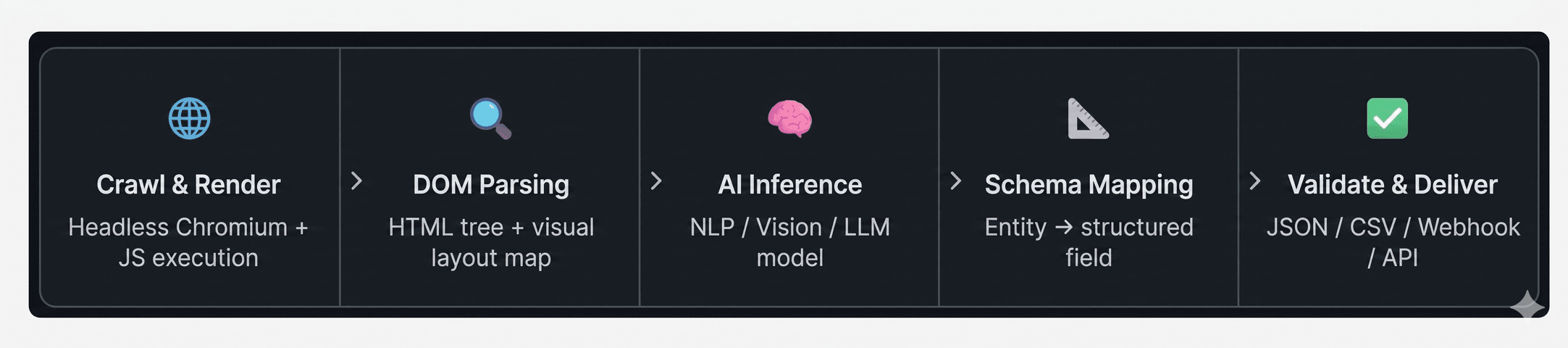
Modern AI extraction pipelines are not a single model doing everything. They are a layered architecture where specialised technologies hand off to each other — from the raw URL input to a clean, validated output record your database can consume.
Understanding each layer explains why AI extraction is so much more resilient than its predecessor and where the real engineering work happens.
Which technologies power each layer?
Natural Language Processing (NLP)
drives entity recognition across page text. Named Entity Recognition (NER) models scan the full body of content and tag every string that matches a data type — a price, a company name, a date, a job title, a geographic location — regardless of where it sits in the HTML structure.
This is what allows the same extractor to pull a salary from a job listing whether it appears in a header, a paragraph, or a structured<table>row. The model reads the content semantically, not positionally, which means structural variance across pages does not produce extraction failures.
Large Language Models (LLMs)
have introduced the most significant capability shift in the extraction space: prompt-driven schema definition. Rather than writing extraction rules per domain, you describe what you need in plain language — “extract the product name, current price, stock status, and customer rating from this e-commerce page” — and the LLM reads the page and returns a structured JSON object matching your description.
Platforms built on GPT-4, Claude, and Gemini now offer this natively, reducing the setup time for a new data source from weeks of selector engineering to a single well-written prompt and a validation pass.
Computer vision models
address pages where critical data is rendered visually rather than in readable HTML — product catalogues built with image carousels, scanned documents, CAPTCHA challenges, and data locked inside PDFs or image-heavy layouts. Vision transformers identify table structures, form fields, and data regions by their visual position on the rendered page — the same approach a person uses when skimming a document for relevant numbers or names, rather than reading the underlying source code.
The most capable platforms in 2026 combine all three layers in sequence: Chromium renders the page, NLP identifies text entities, computer vision processes visual elements, and an LLM assembles the final structured output according to a user-defined schema.
No single model handles all of this alone — the reliability comes from the handoff between specialised components, each doing what it is best suited for.
What Are the Real Business Benefits of Switching to AI-Powered Extraction?
Teams that self-build rule-based pipelines routinely undercount the true cost. Developer time repairing broken selectors, QA cycles catching silent failures, and the opportunity cost of data gaps during maintenance windows typically exceed the subscription cost of a well-chosen AI data extraction platform within the first year.
94%
reduction in selector maintenance time reported by enterprise data teams after switching to AI extraction
50+
languages handled natively by LLM-based extractors, enabling global data collection without per-language engineering work
10×
faster setup time for new data sources compared to rule-based scrapers requiring custom selector development
Pipelines that maintain themselves after site changes:
When a target website updates its layout or migrates its frontend framework, an AI extractor detects the change and re-inferences the new structure automatically. A site redesign no longer generates a stack of support tickets and engineering work — the model re-reads the new structure and continues extracting. This alone accounts for the majority of the maintenance time savings teams report after switching.
Unstructured content becomes usable, structured data:
Product reviews, forum discussions, news articles, analyst commentary — content that no XPath rule could meaningfully process — is now extractable as structured fields: named entities, topics, sentiment scores, and summaries. This opens up entirely new categories of data that organisations previously had to process manually or ignore entirely.
Scale without proportional engineering cost:
One AI extraction configuration can be applied across thousands of domains. Traditional scrapers required separate engineering work per domain. AI extraction requires a schema definition and a model call — adding a new source is a configuration task, not a development sprint.
Faster time from data need to usable dataset:
A data use case that previously required weeks of selector engineering, QA testing, and ongoing monitoring can be prototyped in hours using LLM-native extraction tools. The speed difference is particularly significant for teams evaluating a new data source before committing to full pipeline development.
Where Are Businesses Actually Using AI Data Extraction Today?
Active deployment across industries in 2026 is broader than most practitioners realise. AI extraction has moved well beyond competitor price monitoring and is now embedded in core data infrastructure across finance, real estate, recruiting, logistics, and AI development itself. Below are six categories where production use is already documented at scale.
🛒 E-Commerce Price Intelligence
Retailers extract competitor pricing, promotional timelines, and stock levels across thousands of product lines in real time — feeding repricing systems that update margins automatically based on what competitors charge at any given moment, without human review between data collection and price update.
📈Financial Data Aggregation
Investment firms extract earnings reports, regulatory filings, analyst commentary, and news sentiment from hundreds of structurally different sources simultaneously — converting unstructured financial content into structured time-series datasets that quantitative models can consume directly for backtesting and signal generation.
🏠Real Estate Intelligence
Property platforms aggregate listings, price histories, planning applications, and agent performance data from dozens of regional portals — each structured differently — and normalise everything into a single consistent schema in near real time, giving analysts a unified view of market activity that no single portal provides.
🤖AI Training Data Collection
Teams building large language models use AI extraction to collect high-quality, domain-specific datasets from the public w— pulling structured question-and-answer pairs, factual records, and annotated text for fine-tuning and preference learning pipelines at the volume those processes require.
🎯Sales Intelligence and Lead Enrichment
Go-to-market teams extract company profiles, technology stacks, hiring signals, funding rounds, and leadership changes from public sources — keeping CRM records current without analysts spending hours on manual research that becomes outdated within weeks of completion.
⚖️Regulatory and Compliance Monitoring
Legal and compliance teams monitor government portals, regulatory agency publications, and court records across jurisdictions — extracting structured alerts from dense legal text the moment new filings or rulings are published, rather than relying on periodic manual checks that introduce lag into compliance workflows.
What Are the Biggest Challenges and Limitations You Need to Know?
AI extraction is capable, but treating it as a fully autonomous, zero-oversight process is how production data pipelines develop quality problems that go undetected for weeks. The limitations below are real, specific, and manageable — but only if you account for them when designing the pipeline rather than after the first silent failure reaches downstream systems.
Anti-bot infrastructure has become sophisticated and expensive to bypass:
Cloudflare, DataDome, PerimeterX, and Akamai Bot Manager analyse browser fingerprints, TLS signature patterns, and behavioural signals to identify automated traffic at a level that goes far beyond simple IP blocking. Even crawlers with realistic browser fingerprints get challenged regularly. Residential proxy rotation and configured stealth browsers help, but each adds cost and latency per request — costs that must be built into your pipeline budget before you commit to production scale.
LLM-generated output requires validation — models can return plausible but wrong values:
When an LLM-based extractor encounters an ambiguous or partially missing data field, some models will return a plausible-looking value rather than a null — filling the gap in a way that introduces errors without any visible failure signal. For financial records, medical data, or legal documents, this behaviour is not acceptable and can cause real harm downstream. Every AI extraction pipeline in production needs confidence scoring, schema-level type validation, and a review queue for low-confidence outputs before that data reaches any decision-making system.
JavaScript-heavy pages add significant rendering time at scale
Full Chromium rendering for JavaScript-heavy single-page applications takes considerably longer than simple HTTP fetching — typically three to eight times longer per page, depending on page complexity and network conditions. Across millions of URLs, this latency becomes a real infrastructure cost that affects both pipeline throughput and the bill for cloud compute. Factor this into your architecture and cost projections before scaling.
The legal framework around large-scale extraction is still being defined
The Computer Fraud and Abuse Act, GDPR Article 6 lawful basis requirements, and the enforcement of Terms of Service across platforms are all actively contested in courts and regulatory proceedings. The hiQ v. LinkedIn ruling established that scraping publicly accessible data does not automatically constitute a CFAA violation in the US — but this is not universal, and non-US jurisdictions have different standards. Any commercial-scale extraction operation needs proper legal review, not just a robots.txt check.
Data quality note: Never run an AI extraction pipeline in production without validation logic in place. Build schema-level type checks, range validations, completeness thresholds, and anomaly detection into your pipeline from the start. A confident but incorrect value is harder to catch than an empty field and causes significantly more damage to downstream decisions and reporting.
Is Outsourcing Your AI Data Extraction to a Big Data Provider the Right Choice for You?
Building an AI extraction stack in-house is technically possible — but it is also expensive and time-consuming to do properly. You need proxy infrastructure, headless browser orchestration, LLM API cost management, schema validation logic, monitoring dashboards, and engineers who understand all of it well enough to debug failures at 2am. For most organisations, that is not a core function — it is a significant distraction from the business problem the data is supposed to help solve.
Outsourcing to a specialist data provider makes the clearest sense when your team’s time is better spent using data than building and maintaining the infrastructure to collect it. The managed extraction market in 2026 has matured to the point where you can get production-grade AI extraction — complete with anti-bot handling, LLM-native schema definition, and structured delivery to your data warehouse — at a predictable per-URL or subscription cost that is typically lower than the fully-loaded engineering cost of building and running the same capability yourself.
That said, outsourcing is not the right answer for every situation. The criteria below help clarify when each path makes sense:
Outsource if…
Your team has no dedicated data engineering capacity, you need working pipelines quickly, your extraction needs span many different domains, or your use case requires 24/7 reliability that you cannot support with internal on-call coverage.
Build in-house if…
You have highly specific extraction requirements that managed tools do not address, your data is sensitive and cannot pass through third-party infrastructure, or your volume is large enough that per-URL pricing makes managed services more expensive than owned infrastructure over a 12-month horizon.
Hybrid approach
Many organisations outsource the extraction layer — crawling, rendering, anti-bot handling — while keeping schema definition, validation, and data pipeline logic in-house. This captures the cost efficiency of managed infrastructure without giving up control over how the data is structured and used.
Questions to ask providers
What is your data retention and deletion policy? Do you resell extracted data to other customers? What SLA do you offer on uptime and data freshness? How do you handle LLM output that does not match the expected schema? Can schemas be defined in plain language or only through API configuration?
Conclusion
AI data extraction represents a structural change in how organisations collect and use information from the public — not a cosmetic improvement layered on top of the same underlying approach. Moving from selector-based scrapers to extraction systems that understand page content semantically removes the primary reason data pipelines fail at scale: they break the moment a site changes.
When a site redesigns, an AI extractor re-reads the new structure. When content is unstructured prose, a language model parses it into fields. When the page is primarily visual, a vision model processes it. When your data model changes, you update a prompt — not a codebase built on fragile HTML addresses.
Organisations that extract structured, reliable data from the in 2026 do not necessarily collect more data than their competitors. They collect better-structured, more consistently formatted, and more reliably maintained data — at lower operational cost and with less ongoing engineering work. That difference shows up in the quality of decisions made downstream. Whether you build your extraction stack in-house, partner with a managed data provider, or use a hybrid approach, the practical shift is the same: the technical barriers that once made large-scale data collection expensive and unreliable have been substantially reduced. The work now is deciding what data to collect and what to do with it.
FAQs
1. Is AI data extraction legal?
Generally yes, if you’re pulling publicly visible data. The gray area starts when you scrape personal information, content behind a login, or data that violates a site’s Terms of Service. Always check the site’s terms and robots.txt file before running anything
2. How to use AI in data extraction?
AI enhances data extraction by automatically identifying and parsing relevant content from pages using NLP and machine learning, eliminating the need for hard-coded rules or selectors.
3. Can AI be used for scraping data directly?
Yes, AI-powered scrapers can navigate dynamic websites, handle CAPTCHAs, adapt to layout changes, and extract structured data intelligently — making them far more robust than traditional scrapers.
Get Notified !
Receive email each time we publish something new: