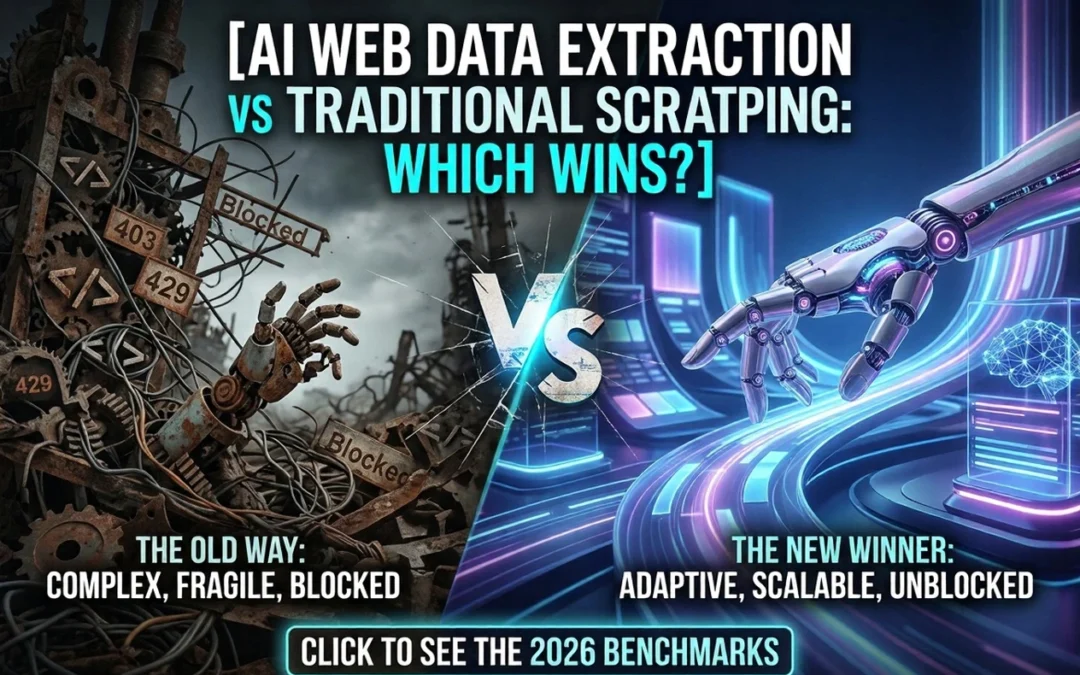
AI data extraction vs traditional scraping which wins?
Author : Jyothish
AI data extraction vs traditional scraping which wins?
Author : Jyothish
AIMLEAP Automation Works Startups | Digital | Innovation | Transformation
Table of Contents
1. AI Data Extraction vs Traditional Scraping: Which One Actually Fits Your Project?
2. What Does Traditional Scraping Actually Do, and Where Does It Stop Working?
3. How Does AI-Based Extraction Work Differently Under the Hood?
4. Speed, Accuracy and Cost: How Do the Two Methods Compare Side by Side?
5. Dynamic Sites, Anti-Bot Measures and JavaScript Rendering: Who Handles This Better?
6. Is It Legal? What You Need to Know About Compliance Before You Start?
7. Real Projects, Real Decisions: Which Approach Worked and Why
8. How to Decide Which Method to Use: A Practical Decision Framework
9. Frequently Asked Questions About AI Extraction and Traditional Scraping
AI Data Extraction vs Traditional Scraping: Which One Actually Fits Your Project?
Most scraping projects start the same way: someone needs data, a developer writes a script, and it works fine for a few weeks.
Then a site updates its layout, and half the pipeline breaks. If you have been managing scrapers in production, that story is almost certainly familiar. In 2026, teams are increasingly turning to AI-powered extraction to solve exactly this problem, but it is not always the right choice for every project.
According to data from multiple production environments tracked by Outsourcebigdata, teams maintaining rule-based scrapers across 10 or more websites spend an average of 30% of their engineering time just keeping those scrapers alive, not improving them, just keeping them from breaking. That number climbs sharply when dynamic, JavaScript-heavy sites are in the mix.
This article breaks down both approaches honestly, without pushing either one as universally superior.
You will understand how each method works under the hood, see a side-by-side comparison on real metrics like cost, accuracy, and maintenance, and walk away with a practical decision framework you can apply to your specific situation. If you are considering a hybrid approach, there is a section on that too.
What Does Traditional Scraping Actually Do, and Where Does It Stop Working?
Traditional scraping is built on structure. A scraper reads the HTML of a page, navigates its DOM tree using CSS selectors or XPath expressions, finds the specific elements containing the data it needs, and extracts them.
Libraries like BeautifulSoup and Scrapy handle the heavy lifting for most Python-based workflows. For pages that require browser interaction, such as dropdown menus or JavaScript-rendered content, Selenium or Playwright steps in to simulate a real browser session.
When the site is consistent and the HTML structure does not change, traditional scrapers work extremely well. They are fast, inexpensive to build, and easy to debug because the logic is explicit. A developer can look at the script and immediately understand what it is selecting and why. That clarity is genuinely valuable when you need auditability or when you are working in a regulated environment.
How a Rule-Based Scraper Reads a Page
Here is a simplified example of how a traditional scraper targets a product price. It locates an element like div.product-price span.amount and extracts the text inside. This works perfectly until the site’s developer renames the CSS class to price-wrapper or moves the price into a different HTML element entirely.
At that point, the scraper returns nothing, or worse, it returns the wrong value silently. This is what engineers mean when they say a scraper is fragile: it is tightly coupled to the exact structure of the page at a specific moment in time.
In practice, even minor front-end redesigns, A/B tests, or CMS template updates can cause a rule-based scraper to fail. The scraper does not understand what a price is. It only knows where a price was on the day it was written.
Where Traditional Scrapers Still Make Sense in 2026
Despite their fragility on dynamic sites, rule-based scrapers are absolutely the right tool in several scenarios. At Outsourcebigdata, we still recommend them for projects that meet specific conditions:
- Government or regulatory databases with stable, long-term HTML structures
- Internal data feeds where you control the source system
- Academic repositories and research portals with consistent, standard HTML
- Smaller projects with a handful of sources and low update frequency
- Budget-constrained projects where LLM API costs are not justified by the scale
The honest answer is that traditional scraping has not become obsolete. It has simply found its natural habitat, and that habitat is smaller, more predictable data projects where the maintenance overhead is manageable.
How Does AI-Based Extraction Work Differently Under the Hood?
AI-based extraction does not rely on specific HTML structure at all. Instead, it uses language models and natural language processing to understand what the page content means and extract the relevant data semantically.
Think of it this way: a traditional scraper is handed a recipe card and instructed to find the third line under the Ingredients heading. An AI extractor is shown a dish and asked to identify the ingredients, regardless of how the recipe is formatted or whether it is on a card, a website, or a photo.
In practical terms, an AI extractor is given instructions in plain language, for example: find the job title, the company name, the salary range, and the posting date, and it applies those instructions to whatever HTML, rendered text, or structured content it receives. The model figures out the layout independently each time. This is why AI extractors continue working correctly even when a site completely redesigns its front end.
From Fixed Rules to Understanding Context: What Actually Changes
The difference is best illustrated with a concrete comparison. A traditional scraper might be written to target the CSS selector span.listing-salary on a job board.
An AI-based extractor is given an instruction like: extract the salary information from this job posting, and it correctly identifies the salary whether it appears in a table, a badge, a paragraph, or a tooltip. It handles the information whether it is formatted as a number, a range, or a phrase like competitive salary, and it can flag ambiguous cases for review.
Prompt-based extraction also allows non-technical users to define what they want extracted without writing code. This significantly reduces the specialist knowledge required to set up and modify extraction tasks, which lowers the operational cost of running and updating data pipelines.
Why AI Scrapers Keep Running When a Site Redesigns
When a website changes its layout, a traditional scraper needs a developer to update the selectors before it can function again. An AI-powered pipeline detects the layout change automatically, adapts its understanding of the page, and continues extracting correctly.
This capability is commonly referred to as self-healing extraction, and it has measurable impact on maintenance costs. Teams that have switched from traditional to AI-based extraction have reported maintenance reductions of 60 to 80 percent, particularly when working across large numbers of diverse source websites. At Outsourcebigdata, we have observed this pattern consistently across client projects in retail, travel, and financial data aggregation.
Speed, Accuracy and Cost: How Do the Two Methods Compare Side by Side?
This is where the decision often comes down to specifics. The numbers below reflect real production data gathered across projects at Outsourcebigdata and corroborated by published research on LLM-based data extraction. Context matters heavily here: a metric that looks impressive in one project may be irrelevant in another.
| Factor | Traditional Scraping | AI-Based Extraction | Hybrid Approach |
| Setup Time | Low (hours) | Medium (days) | Medium |
| Maintenance | High (breaks often) | Low (self-healing) | Low to Medium |
| Accuracy (static) | Near 100% | 99%+ | Near 100% |
| Accuracy (dynamic) | 60-80% | 99.5%+ | 99%+ |
| JS / Dynamic Sites | Needs Selenium | Handles natively | Best of both |
| Cost (12 months) | Dev time heavy | LLM API + lower dev | Optimised |
| Scale (50+ sites) | Breaks frequently | Adapts automatically | Recommended |
| Best For | Static, predictable | Complex, varied | Enterprise scale |
Accuracy: When 99.5% Matters and When It Does Not
On static, well-structured websites, traditional scrapers can achieve accuracy levels very close to 100%, provided the selectors are maintained and the site does not change. AI-based extraction on complex, dynamic pages with varied layouts typically achieves 99.5% accuracy, which sounds similar but the difference shows up at scale.
Across 10 million extracted records, a 0.5% error rate equals 50,000 incorrect values, which may or may not be acceptable depending on the use case. For financial data or legal records, that matters. For e-commerce price monitoring, it may not.
What Does Scraping Really Cost Over 12 Months?
The setup cost of a traditional scraper is low. A developer can build a functional scraper for a single site in a day or two. The long-term cost is where the picture changes. Projects monitoring 50 or more websites with traditional scrapers have been documented to require over 100 developer-days per year in maintenance alone. AI-based pipelines shift that balance: higher initial setup and ongoing LLM API fees, but dramatically lower maintenance overhead. For most projects beyond 15 to 20 sources, the total cost of ownership favours AI-based extraction within six to twelve months.
Speed on JavaScript-Heavy Pages: Is the Gap as Big as Reported?
Some vendors claim AI scrapers are 30 to 40 percent faster on JavaScript-heavy pages. This claim needs context. On simple, static HTML pages, traditional scrapers are faster because they do not require LLM inference at extraction time.
The speed advantage for AI extraction appears specifically on dynamic pages where traditional scrapers require full browser rendering through Selenium or Playwright, which carries its own significant overhead. The honest summary is that speed parity exists on static content, and AI approaches have a meaningful advantage on complex dynamic content.
Dynamic Sites, Anti-Bot Measures and JavaScript Rendering: Who Handles This Better?
This section addresses what is genuinely the most common pain point in production scraping. The modern is heavily JavaScript-dependent. Product listings load via AJAX calls. Prices update in real time. Infinite scroll replaces pagination.
Content appears only after user interactions like clicking, hovering, or scrolling past a threshold. Traditional HTTP-only scrapers retrieve the raw HTML before JavaScript executes, meaning they often get an empty shell of a page with none of the actual data they need.
Why JavaScript-Rendered Content Breaks Most Traditional Scrapers
When a traditional scraper sends a GET request to a product listing page, it receives the HTML served by the server, which may contain nothing more than a loading spinner and the JavaScript bundles responsible for populating the content. The actual product data lives in API responses that fire after JavaScript execution. Without running those scripts in a real browser environment, the scraper misses everything. Adding Selenium or Playwright solves this but adds significant infrastructure overhead, slows extraction speeds, and requires maintenance of its own.
How AI Tools Handle CAPTCHAs and Bot Detection Differently
Modern bot detection systems fingerprint browser behaviour: mouse movement patterns, keystroke timing, scroll velocity, and the presence of browser automation flags in the JavaScript environment. Traditional scrapers running through headless browsers are detectable with moderate effort. AI-powered tools built for production use incorporate human-like interaction patterns, proxy rotation, and behavioural fingerprinting awareness.
That said, this is an area where overclaiming is common. No scraping tool, AI-powered or otherwise, guarantees successful bypass of aggressive bot protection on every site. Sites with sophisticated defences like Cloudflare Enterprise or Akamai Bot Manager require specialised approaches regardless of the extraction method. Outsourcebigdata evaluates each source site’s bot protection level as part of initial project scoping, which prevents surprises later in the pipeline.
Is It Legal? What You Need to Know About Compliance Before You Start
Legal compliance is frequently absent from technical comparisons of scraping methods, but it is genuinely important and the landscape has evolved significantly. The key factors are the type of data you are collecting, how you are collecting it, where the data subjects are located, and what the source site’s terms of service specify.
Public Data vs Personal Data: Where the Legal Line Sits
Publicly accessible data, meaning information visible to any visitor without authentication, generally occupies a more permissive legal space. The hiQ v. LinkedIn ruling in the United States established that scraping publicly available data is not a violation of the Computer Fraud and Abuse Act, though this applies specifically to public-facing data and not to data behind login walls.
The situation changes when scraped data includes personally identifiable information covered by GDPR or CCPA. Even if the data is technically visible without login, collecting and storing it in a way that enables individual identification triggers compliance obligations. For teams scraping data involving EU residents, data minimisation, purpose limitation, and storage constraints apply. Indian readers should also be aware of the Digital Personal Data Protection Act of 2023, which introduces consent requirements and data processing obligations for organisations handling personal data of Indian citizens.
Does AI Scraping Create More or Less Legal Exposure Than Traditional Methods?
The extraction method itself does not determine legal exposure. What matters is what data is collected, from where, and how it is used. However, AI-powered extraction pipelines are increasingly designed with compliance-first architecture. They can include built-in filters that identify and discard personal data before it enters the pipeline, maintain audit logs of extraction activity, and enforce consent-aware collection policies. Traditional scrapers can be built with these features too, but they require deliberate implementation. The default behaviour of a naive scraper is to collect everything it finds, which can create compliance problems before anyone realises it.
Real Projects, Real Decisions: Which Approach Worked and Why Service
E-Commerce Pricing Across 50+ Sites: How One Team Made the Switch
A retail analytics team started with traditional scrapers monitoring five competitor websites. Scripts were straightforward and required minimal maintenance because the sites were relatively stable. When they needed to scale to 55 sources across different geographies and site architectures, the maintenance burden became unsustainable. Selectors broke multiple times per week as promotional layouts changed seasonally. After migrating the dynamic-layout sources to an AI-based pipeline managed by Outsourcebigdata, maintenance incidents dropped by 71% and data freshness improved from daily to near-real-time for the highest-priority sources.
Travel Data Aggregation: What Happened When Layouts Changed Overnight
A travel data aggregator was collecting pricing and availability from 30 booking sites using a mixed traditional scraping setup. Three of those sites redesigned their search results layouts during a single week in peak season, instantly breaking the scrapers for those sources right when the data was most commercially valuable. Switching those sources to AI-powered extraction resolved the problem within hours rather than the days it would have taken to manually rewrite the selectors. The remaining 27 sources on stable HTML structures continued to run on traditional scrapers without any change.
When Traditional Scraping Was Still the Right Call
A government contract project required collecting structured data from three federal databases that had maintained consistent HTML for over four years and were explicitly designed for public data access. The data contained no personal information, update frequency was weekly, and the project budget was fixed. Using AI extraction would have added unnecessary LLM API costs and complexity for a problem that a simple, well-maintained Scrapy spider solved reliably. This outcome reinforces a point Outsourcebigdata repeats to every client: the newest technology is not always the right technology. Match the tool to the actual requirements.
How to Decide Which Method to Use: A Practical Decision Framework
After working through dozens of data extraction projects across different industries, the team at Outsourcebigdata has distilled the selection process into a set of questions that reliably lead to the right choice. Run through these before committing to an architecture.
Five Questions to Ask Before Choosing Your Method
| Decision Framework: Choose the Right Scraping Method |
| 1. Is the target site static HTML or JavaScript-rendered? (JS-heavy = AI has clear advantages) |
| 2. How many source sites are you scraping? (15+ sites = AI or hybrid pays off faster) |
| 3. How often do these sites redesign or update their layouts? (High frequency = AI strongly preferred) |
| 4. What is your 12-month maintenance budget in developer hours? (Low budget = AI wins on TCO) |
| 5. Does the data contain personal information subject to GDPR or CCPA? (Yes = need compliance-aware pipeline) |
When Running Both Methods Together Makes More Sense Than Picking One
The majority of enterprise-scale data projects at Outsourcebigdata end up using a hybrid architecture. Rule-based scrapers handle sources with stable, predictable HTML where the traditional approach delivers near-perfect accuracy at low cost. AI extraction handles the dynamic, varied, or frequently-changing sources where maintenance overhead would otherwise dominate. The two layers run in parallel, each applied to the sources it is best suited for. This is not a compromise solution; it is often the most cost-efficient and reliable architecture available for large-scale, multi-source data collection.
Frequently Asked Questions About AI Extraction and Traditional Scraping
These questions come directly from developer communities, Reddit discussions, and the People Also Ask section for queries around how AI data
extraction works. They represent the real concerns of people evaluating these methods.
1. Can AI scraping completely replace traditional methods?
Not in all cases, and it probably should not. For stable, structured sources with consistent HTML and low update frequency, traditional rule-based scrapers deliver better accuracy and lower per-page cost than AI extraction. The realistic answer is that AI extraction is the better primary method for dynamic, varied, or large-scale scraping projects, while traditional scrapers remain the practical choice for simpler, stable sources. Most mature data teams use both.
2. Do I need to know how to code to use an AI scraper?
Modern AI-based extraction platforms are designed to be accessible to non-developers. You describe what you want extracted in plain language, and the tool handles the technical implementation. That said, production deployments at scale, particularly those involving custom pipelines, compliance requirements, or complex authentication, still benefit from technical oversight. Outsourcebigdata offers managed extraction services that handle the technical layer entirely while giving clients clean, structured data outputs.
3. How much does AI data extraction actually cost per page?
Costs vary by provider and volume. LLM inference for extraction typically adds between 0.1 cents and 1 cent per page depending on page complexity and the model used. At high volumes, this cost drops significantly through caching and prompt optimisation. Compare this to the engineer-hours required to maintain traditional scrapers at scale and AI extraction typically becomes cost-positive at volumes above 100,000 pages per month across varied sources.
4. Which method is better for feeding data into an LLM pipeline?
AI extraction pipelines are inherently better suited here because they can produce clean, structured, semantically organised outputs rather than raw HTML dumps. When the downstream consumer is a language model or a RAG pipeline, receiving pre-extracted, contextualised data improves output quality and reduces token consumption. Outsourcebigdata has built several LLM-ready data pipelines for clients in financial services and market intelligence.
5. Does scraping data break any privacy laws?
It depends entirely on what is being scraped and where the data subjects are located. Scraping publicly available, non-personal data is generally permissible in most jurisdictions, though some countries and site terms of service impose additional restrictions. Scraping data that includes personal information identifiable to specific individuals, particularly EU residents covered by GDPR or Indian citizens covered by the DPDP Act, requires legal review. The safest practice is to scrape only what you need, avoid personal data where possible, and implement data minimisation controls in your pipeline.
6. Ready to Build a Smarter Data Pipeline with Outsourcebigdata?
Whether you are evaluating your first scraping project or reconsidering an existing pipeline that is costing too much in maintenance, Outsourcebigdata works with teams to design extraction architectures that match the actual problem. We do not default to the newest technology or the cheapest option. We run the numbers for your specific sources, your scale, and your compliance requirements, and recommend what actually fits. Get in touch with our data team at outsourcebigdata.com to start a conversation.
Get Notified !
Receive email each time we publish something new: