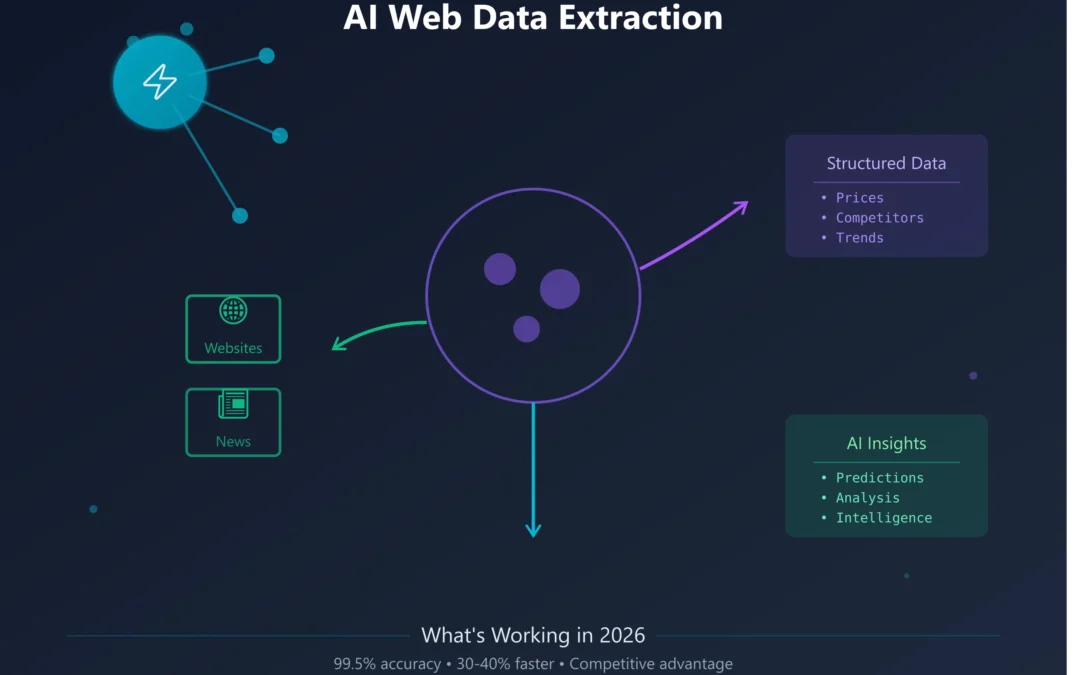
AI Data Extraction Use Cases for Businesses: What Is Working in 2026
Author : Jyothish
AI Data Extraction Use Cases for Businesses: What Is Working in 2026
Author : Jyothish
AIMLEAP Automation Works Startups | Digital | Innovation | Transformation
Table of Contents
- AI Data Extraction Use Cases for Businesses: What’s Actually Working in 2026
- What does data extraction actually mean for a business?
- The business problems data extraction solves most often
- Which industries get the most out of data extraction — and why
- What separates a useful data pipeline from one that breaks every time a website updates
- Is it legal to collect data from websites — and what do you actually need to know?
- How do businesses measure whether their data extraction investment is paying off?
- Where to start if your business has never automated data collection before
- Frequently Asked Questions
AI Data Extraction Use Cases for Businesses in 2026
Every business collects data. The difference in 2026 is how fast you can get it, how clean it is when it arrives, and whether your team had to stop what they were doing to gather it manually.data extraction has quietly become one of the most important tools in a modern business stack, and the companies getting real value from it are not the ones with the biggest tech budgets. They are the ones who identified one clear problem, connected it to publicly available data on the, and automated the collection.
This guide covers what data extraction actually does for businesses across industries, where it is being used right now, what the legal boundaries look like, and how to know if it is the right fit for your operation. No jargon. No vendor pitch. Just practical context from a team that works with data pipelines every day.
What Does Data Extraction Actually Mean for a Business?
data extraction is the process of automatically pulling structured or semi-structured information from websites and turning it into something your systems can use, whether that is a spreadsheet, a database, a dashboard, or a live feed into your CRM. The older term is scraping, but modern pipelines go far beyond copying HTML. Today, tools use machine learning models to understand the meaning of content on a page, not just its position in the code. That distinction matters because websites change constantly. A scraper that relies on a fixed element ID will break the moment a designer updates the page. A system trained to understand what a price, a product name, or a review looks like will adapt.
At Outsourcebigdata, we see three types of business data needs that extraction serves consistently well:
- Competitive intelligence: knowing what competitors are doing, pricing, launching, and hiring
- Market and customer research: understanding how people talk about products, services, and trends in public spaces
- Operational data feeds: pulling real-time information that does not come through a standard API, such as port schedules, regulatory bulletins, or property listings
Why Manual Data Collection Stops Scaling
There is a clear breaking point for most teams. A sales analyst checks competitor pricing once a week by visiting five websites. That works fine until the list grows to fifty websites, the check needs to happen daily, and the analyst has twelve other responsibilities. The same pattern repeats in marketing, product, finance, and procurement. The moment the data need outpaces the person, the organization faces a choice: hire more people to do repetitive work, or automate it. Automated extraction answers that with a well-maintained data pipeline that runs while your team is focused on analysis, not collection.
The Business Problems Data Extraction Solves Most Often
Tracking Competitor Pricing Without a Full-Time Analyst
Price intelligence is the most widely adopted use case for data extraction, and for good reason. In e-commerce, a price difference of 3% on a high-volume SKU can shift thousands of orders. Retailers who monitor competitor pricing across dozens of sites in real time can adjust dynamically rather than reacting weeks later when margin loss shows up in a report.
What typically gets extracted:
- Product prices and sale prices across competitor listings
- Stock availability signals (out of stock, limited stock, pre-order)
- Promotional banners and discount patterns
- Assortment gaps, i.e., categories where competitors stock products you do notReal Outcome One mid-size online retailer working with a managed data pipeline reduced the time between a competitor price change and an internal pricing adjustment from 72 hours to under 4 hours. That gap was where margin was being lost.
Building Lead Lists That Do Not Go Stale Before Your Sales Team Calls Them
Static B2B databases are a well-known frustration for sales teams. Contact information becomes outdated, job titles change, and companies that looked like strong prospects six months ago have already bought from a competitor. extraction solves this by pulling intent signals directly from public sources in near real time.
High-value data sources for B2B lead generation:
- Job postings: a company hiring three data engineers is probably building a pipeline
- Funding announcements from Crunchbase and news sites
- Company directory listings with updated firmographic data
- LinkedIn company page updates (where terms of service permit)
- Event registration pages listing attendees from target companies
Research from LinkedIn shows that B2B buyers are significantly more likely to engage when outreach is based on timely business signals, such as a new hire or a funding round, rather than generic demographics. Outsourcebigdata builds lead generation pipelines for clients that refresh prospect data on a daily or weekly cadence, keeping sales teams working from current information rather than guessing.
Reading Customer Sentiment at Scale Across Reviews and Forums
A customer writes a review on a third-party platform. Another posts a complaint on Reddit. A third shares feedback in an industry forum. None of this reaches your customer service team in a structured form, yet all of it contains direct signals about how your product or service is performing and where competitors are falling short.
extraction combined with natural language processing makes it possible to:
- Aggregate reviews from Google, Trustpilot, G2, Amazon, and niche platforms into one dataset
- Identify recurring themes in negative feedback before they become a PR issue
- Track sentiment shifts over time, particularly after a product update or pricing change
- Monitor competitor reviews to find gaps your product can fill
This use case sits at the intersection of product development and marketing. The output is not just a dashboard, it is an early warning system.
Getting an Edge in Financial Markets With Data That Is Not in a Terminal
Institutional investors and hedge funds have used alternative data for years. What has changed is that mid-market investment firms and corporate finance teams now have access to the same pipelines. Alternative data extracted from the includes regulatory filings from the SEC and equivalent bodies, niche news sites that cover specific sectors before mainstream outlets pick them up, executive movement announcements, and patent filings. Analysts at firms with early access to this data can identify trends and signals before they become consensus knowledge.
Deloitte research indicates that early access to alternative data sources can provide investment teams with a meaningful informational edge, particularly in equity analysis and risk assessment.
Watching Your Supply Chain From Public Sources
Supply chain disruptions often show up in public data before they affect your own operations. Port authority bulletins, weather services, government logistics databases, and freight tracking platforms are all publicly accessible and contain signals that matter for planning. Logistics teams that extract and monitor this data can reroute shipments, adjust inventory orders, and notify customers proactively rather than reactively.
How Healthcare and Pharma Teams Use Extraction
Healthcare organizations track drug pricing across payer sites, monitor clinical trial registries for competitive research activity, and aggregate insurance coverage databases that are spread across hundreds of individual plan documents. The data volume is enormous and largely unstructured. Extraction pipelines that can read PDFs, HTML tables, and semi-structured text are particularly valuable in this sector. Note that healthcare data extraction requires strict attention to personal data regulations, which we cover in the compliance section below.
Which Industries Get the Most Out of Data Extraction
E-Commerce and Retail
Digital shelf monitoring, price parity tracking, and assortment analysis are the core use cases. Retailers who depend on marketplace platforms also use extraction to monitor how their own products are displayed and whether unauthorized sellers are undercutting them.
Real Estate
Property pricing trends, foreclosure records, MLS data aggregation, and insurance valuation research all depend on data. Real estate funds use extraction to build proprietary datasets on regional market dynamics that standard data providers do not offer.
Travel and Hospitality
Hotel rate parity monitoring, airline ticket price tracking, and review aggregation from TripAdvisor, Booking.com, and Google are standard practice for travel platforms. The data refresh cycle here is measured in hours, not days.
Recruitment and Talent Intelligence
HR teams and recruiters extract job posting data to understand what roles competitors are hiring for, what skills are in demand, and how salary benchmarks are shifting across regions. This type of market intelligence directly informs workforce planning.
What Separates a Useful Data PipelineFrom One That Breaks Every Time a Website Updates
The hidden cost of data extraction is not the infrastructure. It is maintenance. Engineers at companies running in-house scraping pipelines report that keeping scrapers working consumes more time than building them did. Every website redesign, every anti-bot update, every layout change requires someone to go in and fix the extraction rules.
The architecture that holds up in production shares a few characteristics:
- Scripts written and maintained by machine learning models, rather than raw HTML parsing that breaks on every layout change
- Validation layers that flag when extracted data looks wrong, so you catch a bad extract before it corrupts a downstream report
- Proxy rotation and ethical request pacing to avoid overloading target servers
- Audit trails that log what was collected, when, and from which source, which matters enormously for complianceImportant Distinction There is a meaningful difference between asking a language model to read a page and extract data in real time versus asking a language model to write the extraction script. The first approach is prone to inconsistency and slow at scale. The second produces deterministic, auditable code. One enterprise pilot found that live LLM extraction returned pricing data 20% off the actual value because the model could not reliably distinguish VAT-inclusive from VAT-exclusive prices. Code-based extraction caught the error on the first run.
No-Code Tool, Managed Service, or Custom Build: How to Choose
The right answer depends on your team, your data volume, and how often your target sources change.
- No-code tools (Browse AI, Octoparse): best for small teams with simple, stable sources and low data volumes. Quick to set up, limited on compliance controls.
- Managed services (Outsourcebigdata, Forage AI, ScrapeHero): suited for enterprise volume, complex sources, or situations where compliance documentation matters. The vendor handles maintenance and delivery.
- Custom builds: appropriate when the use case is highly specific, the data is sensitive, or the organization needs full control over the pipeline architecture.
Is It Legal to Collect Data From Websites? What You Actually Need to Know
This is the question that stops more data projects than technical complexity does. The short answer is: collecting publicly available data from websites is generally legal in most jurisdictions, but how you collect it, what you collect, and what you do with it determines whether you stay on the right side of the law.
Key legal frameworks that affect data extraction in 2025:
- GDPR (EU): applies any time extracted data includes personal information about EU residents. The French data protection authority fined one firm 240,000 euros in 2024 for scraping contact data from LinkedIn even when it was technically visible on public profiles. ‘Publicly available’ does not mean ‘free to process.’
- CCPA (California): similar principles apply to California residents’ personal data.
- CFAA (US): governs unauthorized computer access. The hiQ v. LinkedIn ruling established that scraping publicly accessible data does not violate federal law, but circumventing access controls does.
- Robots.txt: regulators and courts are increasingly treating this file as a binding signal. Ignoring it weakens your legal position significantly.
- Terms of Service: violating ToS does not automatically create criminal liability, but it can support civil claims and result in access being blocked.Legal Disclaimer
This section is informational context only and does not constitute legal advice. Before collecting third-party data at scale, consult a qualified legal professional familiar with data protection law in your jurisdiction. Outsourcebigdata operates with GDPR and CCPA compliance built into its pipeline architecture.
Five Questions to Ask Before You Collect a Single Data Point
- Is the data publicly accessible without login or payment?
- Does it include any personally identifiable information about individuals?
- Does the target site’s robots.txt file allow automated access to this path?
- Does the site’s Terms of Service prohibit automated data collection?
- Do you have a documented legitimate interest or other lawful basis if personal data is involved?
How Do Businesses Measure Whether Their Data Extraction Investment Is Paying Off?
ROI from data extraction rarely shows up as a line item in a financial report. It shows up as decisions made faster, reports that no longer take three days to compile, and sales teams that stop calling prospects who switched vendors six months ago. The metrics that tend to move are:
- Time saved on manual data collection, measured in analyst hours per week
- Speed of pricing decisions, measured as time from a competitor price change to an internal response
- Data freshness, measured as the age of the most recent record in a live dataset
- Lead conversion lift when using intent-signal enriched lists versus static databases
From projects managed by Outsourcebigdata, clients typically see meaningful reductions in manual data work within the first 60 days of deployment. The biggest gains tend to come not from the extraction itself but from what happens downstream: analysts who spent 40% of their week pulling data now spend that time analyzing it.
Where to Start If Your Business Has Never Automated Data Collection Before
The most common mistake is trying to solve every data problem at once. Pick one. The clearest candidate is usually the task your team does most often by hand, such as checking competitor prices, refreshing a lead list, or pulling monthly market data into a report.
Start with a source that is clearly public, does not require login, and does not involve personal information. Run a small pilot on a single website or data category. Measure the time saved and the quality of the output before scaling.
If you need support setting up a compliant, production-grade pipeline, Outsourcebigdata works with businesses at every stage of data maturity, from first extraction project to enterprise-scale continuous feeds. Every engagement starts with a scoping conversation about your specific data problem, not a one-size product pitch.
The holds more business-relevant data than most companies ever act on. The gap between collecting it and not collecting it is now also the gap between knowing what is happening in your market and finding out late.
Frequently Asked Questions
The following questions are drawn from Reddit discussions, Google People Also Ask boxes, and common queries from business teams evaluating data extraction for the first time.
What do businesses actually use scraping for day to day?
The most common daily uses are competitor price monitoring, brand and review tracking, lead database refreshing, and news monitoring for market signals. Finance teams also run daily extraction from regulatory and news sources. Most of these run on automated schedules with no human involvement after setup.
How is AI extraction different from a regular scraper?
A traditional scraper targets specific HTML elements by their position in the page code. When the page layout changes, the scraper breaks. AI-based extraction understands content by meaning, so it adapts when a site redesigns. It also handles unstructured content like paragraph text, PDFs, and image-embedded text that traditional scrapers cannot read at all.
Can small businesses afford to use data extraction tools?
Yes. No-code tools like Browse AI start at well under $100 per month and require no technical skills. For more complex needs, managed services like Outsourcebigdata offer scoped engagements rather than open-ended enterprise contracts. The better question is whether the time saved justifies the cost, and for most teams running any manual data collection process, it does.
Is it legal to scrape data from public websites in 2025?
Collecting publicly available, non-personal data from websites is generally legal in most jurisdictions. The key risk areas are: collecting personally identifiable information without a legal basis (especially under GDPR), ignoring robots.txt restrictions, violating a site’s Terms of Service, or overloading a server with requests. Each of these introduces legal or reputational risk even if the underlying data is public.
How often does scraped data need to be refreshed to stay useful?
It depends entirely on the use case. Competitor pricing for an active e-commerce operation may need hourly refreshes. Job postings for a recruitment team might refresh daily. Market research for a quarterly strategy review might run weekly. The refresh cadence should be driven by how quickly the underlying data changes and how quickly your decisions need to respond to it.
What is the difference between scraping and using an API?
An API is a structured, official channel that a company provides for accessing its data. It is cleaner and more reliable but limited to what the company chooses to expose. Web scraping accesses publicly visible information directly from web pages, including data that is not available through any API. Most businesses use both: APIs for platforms that offer them, and extraction for sources that do not.
Get Notified !
Receive email each time we publish something new: