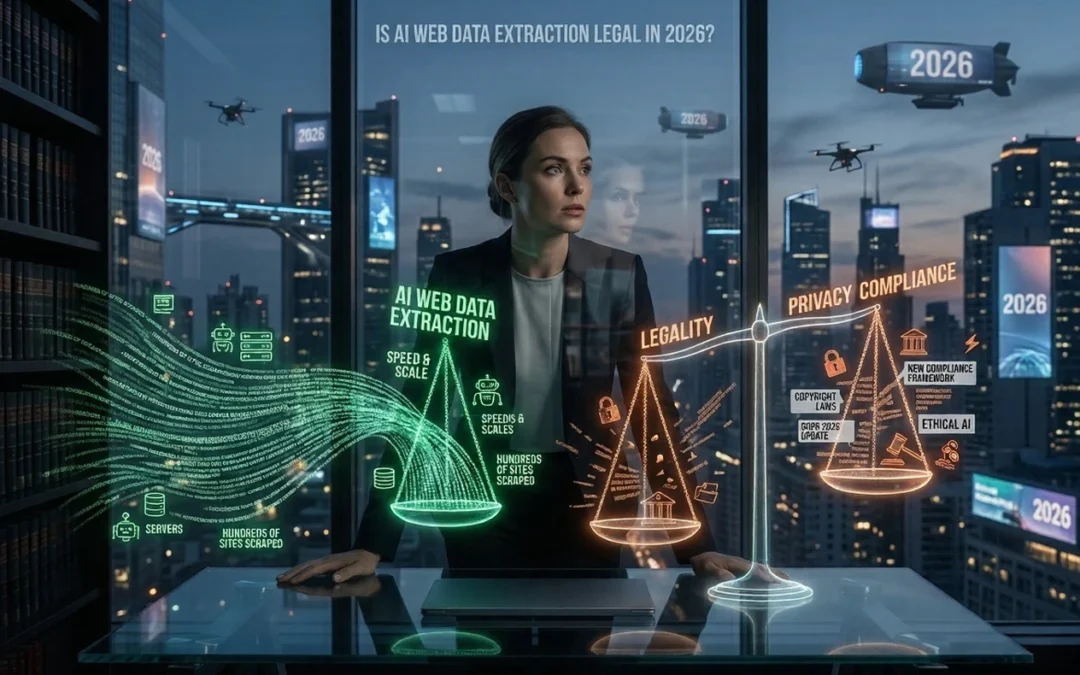
Is AI Data Extraction Legal in 2026?
Is AI Data Extraction Legal in 2026?
AIMLEAP Automation Works Startups | Digital | Innovation | Transformation
Table of Contents
- Is AI Data Extraction Legal in 2026?
- Is AI Data Extraction Legal?
- What Is AI Data Extraction and Why Is It Different From Traditional Scraping?
- Is Scraping Publicly Available Data Actually Legal, or Is That Just a Myth?
- What Role Does a Website’s Terms of Service Actually Play?
- Does It Matter What You Do With the Data After You Collect It?
- How Does the Law Differ Between the US, EU, and Other Countries?
- What Has Actually Changed in 2026? The Court Cases and Rules You Need to Know
- Does robots.txt Stop You Legally, or Is It Just a Polite Request?
- When Does Collecting Someone’s Personal Data Cross the Line?
- Is Using Scraped Data to Train an AI Model Treated Differently by the Law?
- How Can You Extract Data Without Running Into Legal Problems?
- What Should Website Owners Know About Protecting Their Content?
- The Bottom Line From Outsourcebigdata
- Frequently Asked Questions
Is AI Data Extraction Legal?
Extracting publicly available data using automated tools is generally legal in the US under current court rulings. But the answer changes significantly depending on what type of data you collect, whether you bypass access controls, and what you plan to do with it. If you are training an AI model on scraped content, the legal situation is actively contested in multiple courts right now. The law is moving fast. What was settled yesterday may look different by the end of 2026.
If you have ever sat across a table from a client asking whether their data pipeline is going to land them in court, you understand why this question matters. At Outsourcebigdata, we work with companies across industries that rely on data for market intelligence, competitor analysis, AI model development, and operational decision-making. The legal question around data extraction has come up in nearly every serious project conversation we have had in the last two years, and the honest answer in 2026 is this: it depends, and it is more complicated than most blog posts will tell you.
This guide is built from current court rulings, active litigation, EU regulatory enforcement, and the practical reality of running data extraction projects at scale. We are not going to give you a simple yes or no, because that would be doing you a disservice. What we will give you is the clearest, most current picture of where the law actually stands in 2026, what has changed, and how to protect yourself if you are building or running a data extraction operation.
What Is AI Data Extraction and Why Is It Different From Traditional Scraping?
Traditional scraping has been around since the early days of the internet. A developer writes a script using tools like Python with BeautifulSoup or Scrapy, points it at a page, and tells it exactly which HTML elements to pull. It works well right up until the website changes its layout, at which point the whole thing breaks and someone has to go back in and fix it manually.
AI-powered data extraction works differently. Instead of following a rigid set of rules based on HTML structure, AI-driven tools use machine learning and natural language processing to understand the meaning of content on a page. The system recognises that a block of text is a product price, a review, or a job title not because it sits inside a specific CSS class, but because the model understands context. When a site redesigns its pages, an AI scraper adapts. When content appears in an image, computer vision can still read it. This is what makes AI extraction significantly more powerful, and significantly more capable of operating at a scale that catches the attention of lawyers and regulators.
The legal picture matters here because the scale and purpose of AI extraction differ from scraping a handful of product prices. We are now talking about tools that can crawl millions of pages per day, extract personal information from social media at industrial volume, and feed entire corpora of copyrighted text into AI training pipelines. That shift in scale and purpose is exactly why 2026 is proving to be a turning point in how courts and regulators treat this activity.
Is Scraping Publicly Available Data Actually Legal, or Is That Just a Myth?
This is the question we hear most often. The short answer is that scraping publicly available data is generally legal in the United States under current case law. The longer answer is that it comes with important conditions, and those conditions matter enormously.
The landmark case that most people reference is hiQ Labs versus LinkedIn. LinkedIn sent hiQ a cease-and-desist letter threatening action under the Computer Fraud and Abuse Act, arguing that scraping its user profiles constituted unauthorised access to its systems. The Ninth Circuit Court of Appeals disagreed. The court ruled that the CFAA’s prohibition on accessing a computer system “without authorisation” applies to systems protected by access controls, like passwords, not to data that is freely visible to anyone with a browser. The Supreme Court reinforced this view in Van Buren versus United States, narrowing the CFAA further by establishing that violating a website’s Terms of Service alone does not constitute a criminal violation of the act if the underlying data was publicly accessible. The same principle held in Meta versus Bright Data, where even Meta’s significant legal resources could not use the CFAA to stop a commercial scraper from collecting public profile data at scale.
The practical conclusion from these rulings is clear: if you can see the data in a browser without logging in, collecting it automatically does not make you a hacker under US federal law. However, that legal protection evaporates the moment you do any of the following:
- Bypass authentication: Logging in to access data, using credentials that are not yours, or circumventing a paywall puts you squarely within CFAA territory.
- Create fake accounts: hiQ’s final settlement was partly triggered by its use of fake LinkedIn accounts. This is a contract violation and potentially criminal.
- Break through CAPTCHAs or IP blocks: Circumventing these technical measures is increasingly argued to be a violation of DMCA Section 1201, a separate and serious legal risk.
- Extract data from gated or private systems: Any data that requires a credential, subscription, or explicit login to access is protected.
At-a-Glance: Legal Status of Common Scraping Actions (United States)
| Action | Legal Status | Key Risk |
| Scraping public HTML pages | Generally legal | ToS civil claims |
| Scraping behind a login | High legal risk | CFAA criminal/civil |
| Bypassing CAPTCHAs or IP blocks | High legal risk | DMCA Section 1201 |
| Creating fake accounts to scrape | Illegal | Contract + CFAA |
| Scraping for AI model training | Actively contested | Copyright / fair use |
What Role Does a Website’s Terms of Service Actually Play?
Many people assume that if a website’s Terms of Service say “no scraping”, then scraping is illegal. This is a common and understandable misconception, but the law is more nuanced than that.
A Terms of Service agreement is a contract, not a law. Whether that contract is enforceable against you depends on whether you actually agreed to it. Courts distinguish between two types of ToS agreements: browsewrap agreements, where terms are buried in a footer link that you never explicitly clicked, and clickwrap agreements, where you actively ticked a box or clicked a button saying you agreed. Courts have generally been reluctant to hold scrapers to browsewrap terms, particularly for publicly visible data. But if you created an account and agreed to the ToS during that process, those terms become a binding contract. Violating them exposes you to civil claims for breach of contract, even if it does not trigger the CFAA.
The practical risks of a ToS violation short of a court case are also real. Platforms actively monitor for scraping patterns and respond with IP bans, legal notices, and cease-and-desist letters. For companies like Outsourcebigdata that run data extraction projects at scale, respecting ToS and rate-limiting requests is not just a legal consideration, it is operational good practice. A scraper that triggers a platform’s defences is a scraper that stops delivering data.
Does It Matter What You Do With the Data After You Collect It?
Yes. Significantly. This is the part of the legal picture that catches many teams off guard. The act of extracting data and the act of using it afterwards are governed by different bodies of law, and you need to be compliant with both.
Copyright and Creative Content
Raw facts are not copyrightable. Product prices, company names, sports scores, and publicly stated figures are fair game under copyright law. But original creative writing, news articles, blog posts, research papers, song lyrics, and source code are protected. The question courts are actively working through in 2026 is whether using copyrighted content to train an AI model constitutes fair use under US copyright law. The Bartz versus Anthropic case, which settled for $1.5 billion in 2025, is the biggest signal yet that downloading copyrighted works for AI training at scale carries enormous financial exposure. The New York Times versus OpenAI and Microsoft case is still working through the courts, with the Times arguing that AI-generated outputs can reproduce its articles so closely that they directly substitute for the original content.
Personal Data and Privacy Law
This is where teams most commonly underestimate their exposure. Just because someone’s name, email address, or profile information is visible on a public website does not mean it is free to collect and use. GDPR in the European Union applies to the personal data of EU residents regardless of where your servers are located. If you scrape a French user’s data from a US-based server, GDPR follows that data. You need a lawful basis for processing it, typically a Legitimate Interest Assessment for commercial scraping. You must minimise the data you collect, inform data subjects of its use, and be able to respond to deletion requests. The CNIL, France’s data protection authority, fined a company called Kaspr 240,000 euros for collecting LinkedIn data without appropriate consent, even though the profiles were publicly visible.
California’s CCPA received major updates effective January 2026, including new rights for residents to opt out of automated decision-making that uses their personal data. If you are feeding scraped personal data into any kind of AI system, this new provision applies to California residents in your dataset.
How Does the Law Differ Between the US, EU, and Other Countries?
One of the most common mistakes teams make is assuming the law is the same everywhere. It is not, and the gaps between jurisdictions are significant enough to change your entire compliance approach depending on where your users or data subjects are located.
Jurisdiction Comparison: AI Data Extraction in 2026
| Country / Region | Public Data Scraping | Personal Data Rules | AI Training Data |
| United States | Generally legal (CFAA, hiQ) | CCPA applies in CA | Fair use contested in courts |
| European Union | Legal if no personal data | Strict GDPR requirements | EU AI Act + TDMRep apply |
| United Kingdom | Generally legal | UK GDPR applies | TDM exception under debate |
| Canada | Generally legal | PIPEDA applies | No specific AI law yet |
| China / Russia | High restriction | Strict local laws | Assume explicit clearance needed |
United States
There is no federal anti-scraping law in the US. Scraping is governed by the CFAA for access issues, copyright law for content use, CCPA and sector-specific rules for personal data, and contract law for ToS violations. The trend in court decisions has consistently favoured the right to scrape public data, but the AI training use case is pulling those assumptions in a new direction.
European Union
The EU applies the heaviest regulatory framework. GDPR governs personal data. The Database Directive protects structured databases even when individual records are not copyrightable. And from August 2026, the EU AI Act comes into full enforcement. It requires General Purpose AI providers to publish summaries of their training data, respect machine-readable copyright opt-outs, and comply with TDMRep signals. Ignoring those signals is now legally equivalent to ignoring the underlying copyright or privacy rule. The fines are serious: up to 20 million euros or 4% of global annual revenue under GDPR.
United Kingdom
The UK mirrors EU rules on personal data through UK GDPR. The UK government has explored a text and data mining exception that would allow AI training on copyrighted works without a licence, but the proposal has been heavily contested by publishers and content creators and remains unresolved.
What Has Actually Changed in 2026? The Court Cases and Rules You Need to Know
This is the section your competitors’ articles are most likely to have out of date. The legal landscape in 2026 looks materially different from 2024, and several developments have real implications for any organisation involved in data extraction.
Key Legal Developments: 2025 to 2026
- Bartz v. Anthropic: $1.5 billion settlement over copyrighted books used for AI training
- Reddit v. Anthropic (filed June 2025, ongoing): breach of contract, unjust enrichment, trespass to chattels
- Reddit v. Perplexity (filed late 2025, ongoing): DMCA Section 1201 circumvention claims
- NYT v. OpenAI and Microsoft: fair use in AI training, ruling expected late 2026
- YouTube creators v. Nvidia, Snap, Meta: DMCA circumvention applied to video AI training
- EU AI Act: full enforcement from August 2026 requiring training data disclosure
- CCPA 2026 update: California residents can opt out of AI systems using their data
The Bartz versus Anthropic settlement is the clearest signal yet that the days of quietly downloading copyrighted works for training purposes are over. A $1.5 billion settlement is not a slap on the wrist. It tells every AI company with a training pipeline that the exposure is existential if they get the copyright question wrong.
The Reddit cases are interesting for a different reason. Reddit’s lawsuits against Anthropic and Perplexity are deliberately structured to avoid copyright law and the CFAA. Instead, they use breach of contract, unjust enrichment, and trespass to chattels. This approach sidesteps the preemption arguments that have helped scrapers in CFAA cases, and it signals a new legal template that other platforms are watching closely. Reddit’s argument is simple: we built and maintain this platform, we own the relationship with our users, and we have demonstrated the value of this data through paid licensing deals with Google and OpenAI. If you want it, you pay for it. Reddit versus Perplexity goes further, alleging that Perplexity increased its scraping volume 40 times after receiving a cease-and-desist, and directly naming the scraping intermediaries it used. This matters because it puts the entire supply chain of data extraction under legal scrutiny, not just the end AI company.
The EU AI Act coming into full enforcement in August 2026 is the other major shift. Article 53 requires General Purpose AI providers to have a compliant privacy policy and to respect machine-readable signals defining what they can and cannot do with site content. TDMRep, the W3C standard for embedding text and data mining opt-outs into HTTP headers, is now legally binding in the EU. Publishers and website owners who deploy it can expect legal recourse if AI crawlers ignore it.
Does robots.txt Stop You Legally, or Is It Just a Polite Request?
For most of the internet’s history, robots.txt has been treated as a technical convention rather than a legal requirement. It tells automated systems which parts of a site the owner prefers they do not access, but there has been no legal mechanism to enforce it in most jurisdictions. That is changing in 2026, and you need to know how.
In the United States, ignoring robots.txt is not a criminal act, but courts increasingly treat disregard for it as evidence of bad faith. In trespass-to-chattels claims, where a platform argues that excessive scraping harmed its systems, ignoring technical signals like robots.txt strengthens the platform’s case that the scraper was acting recklessly. In the EU, the situation is more direct. Under Article 53 of the EU AI Act, GPAI providers are legally required to respect machine-readable opt-out signals. This brings robots.txt-style controls into legally binding territory for AI training specifically.
Beyond robots.txt, two newer standards are emerging that data extraction teams need to be aware of:
- ai.txt: A newer file type that lets website owners specify purpose-based permissions. A site might allow search engine indexing but explicitly prohibit AI training. This granular control is becoming the standard in 2026.
- TDMRep (Text and Data Mining Reservation Protocol): The W3C standard that embeds permissions directly into HTTP headers. In the EU, this is now the gold standard for legally enforceable opt-outs. If your crawler ignores it, you are not just being impolite, you are potentially violating both IP and privacy law.
Our recommendation at Outsourcebigdata: treat robots.txt, ai.txt, and TDMRep as legally relevant signals regardless of jurisdiction. The cost of respecting them is minimal. The cost of ignoring them is growing quickly.
When Does Collecting Someone’s Personal Data Cross the Line?
Personal data is where the most legal risk concentrates for most extraction projects, and it is the area where teams most consistently underestimate their obligations. The key principle that the EU established and that regulators globally are increasingly adopting is this: the fact that data is publicly visible does not remove your obligation to handle it within the law.
If the data you are collecting can identify a living person, directly or indirectly, it is personal data under GDPR. That includes names, email addresses, phone numbers, location data, IP addresses, and even combinations of seemingly innocuous data points that together make someone identifiable. Profile data on LinkedIn, comments on Reddit, posts on social media, contact information on company websites, all of this qualifies.
For EU data, you need a lawful basis under GDPR Article 6. For commercial scraping, the most commonly used basis is legitimate interest under Article 6(1)(f), but using this requires conducting a Legitimate Interest Assessment that documents your purpose, balances it against the individual’s rights, and demonstrates that your scraping would not override their reasonable expectations. You must also be ready to respond to data subject access requests and deletion requests. A scraping project that collects personal data and has no mechanism to honour deletion requests is not GDPR compliant, regardless of how the data was collected.
Personal Data Compliance Checklist for Extraction Projects
- Identify whether any collected data can identify a living person
- Document your lawful basis before collection begins (legitimate interest is most common)
- Conduct a Legitimate Interest Assessment for GDPR-covered data
- Minimise data: only collect what the project actually needs
- Set retention limits and a deletion schedule
- Build a mechanism to honour data subject access and deletion requests
- Review whether California CCPA 2026 opt-out rules apply to your dataset
Is Using Scraped Data to Train an AI Model Treated Differently by the Law?
Yes. Courts and regulators in 2026 are increasingly treating AI model training as a distinct purpose that requires its own legal analysis, separate from general data collection.
In the United States, the central legal battleground for AI training data is copyright fair use. The four-factor fair use test asks whether the use is transformative, whether it affects the market for the original work, how much of the work was used, and whether the work was commercially published. AI companies have argued that training is transformative because the model learns patterns rather than reproducing the original text. Plaintiffs including the New York Times have argued the opposite, presenting evidence of AI outputs that closely reproduce protected articles in ways that substitute for the original. The courts have not reached a consistent answer yet, and the most anticipated fair use decisions on AI training are expected in mid-to-late 2026.
The emerging commercial reality is also significant. Reddit’s licensing deals with Google and OpenAI, reportedly worth $60 million and $70 million respectively, have established a market price for access to large-scale conversational data. When Reddit then sued Anthropic for scraping the same data without a licence, it was able to point to those deals as evidence that a licensing market exists. In copyright law, harm to an existing licensing market is one of the strongest factors against fair use. This is the argument that could ultimately shift how courts treat AI training data across the board.
At Outsourcebigdata, when we scope AI training data collection projects, our standard advice is: factual, non-copyrighted, public data carries the lowest legal risk. Original articles, creative writing, user-generated content on platforms with active licensing programs, and source code all carry meaningful copyright exposure. For those categories, licensing from the content owner is increasingly the right business decision, not just the ethical one.
How Can You Extract Data Without Running Into Legal Problems?
Running a legally sound data extraction operation in 2026 is absolutely achievable. But it requires treating legal compliance as part of the operational design of your project, not as an afterthought once the pipeline is already running.
Only Work With Data That Is Genuinely Public
If reaching the data requires a login, payment, or bypassing any technical control, stop. The court protections that apply to public data do not extend to authenticated content. This applies even if the data is technically accessible by manipulating a URL.
Respect robots.txt, ai.txt, and TDMRep Signals
Treat these as legally relevant, not optional. In the EU, TDMRep is now legally binding for AI training. In any jurisdiction, ignoring them weakens your position in any legal dispute. Build compliance checks for these files into the first step of every extraction project.
Read the Terms of Service Before You Start
If you will create an account to access the platform, read the ToS carefully. If it prohibits scraping and you click agree, those terms are enforceable against you as a contract. For large-scale projects, a legal review of the target site’s terms is a worthwhile investment.
Set and Enforce Rate Limits
Overloading a server’s resources can constitute trespass to chattels under US law. The eBay versus Bidder’s Edge case established this. A practical default is no more than one request per second per domain. Ethical rate limiting also reduces the chance of your project triggering anti-bot defences that disrupt the pipeline.
Keep Personal Data Out of Scope Where Possible
If your project does not need personally identifiable information, do not collect it. Build a data minimisation step into your extraction pipeline so that personal data is filtered or anonymised before it ever reaches your database. If personal data is unavoidable, document your lawful basis and build a system to handle deletion requests.
Document Your Compliance Decisions
Maintain records of your robots.txt checks, rate limiting configurations, ToS reviews, and legal assessments. If your project is ever challenged, documented good faith significantly reduces your exposure and demonstrates that you operated responsibly.
Consider a Compliant Data Partner
For large-scale or high-risk extraction projects, working through an established data partner like Outsourcebigdata significantly reduces legal exposure. Reputable data extraction providers build compliance infrastructure into their platforms, including robots.txt awareness, rate limiting, GDPR-aligned data handling, and SOC 2 Type II certification. The compliance posture of your data vendor becomes part of your own compliance posture in regulated industries.
What Should Website Owners Know About Protecting Their Content?
Data extraction is not only a question for the people doing the scraping. Website owners and content publishers are increasingly on the other side of this issue, trying to understand what protections they actually have and what steps they can take.
- Update your Terms of Service to explicitly prohibit scraping for AI training purposes, and to require a licence for any commercial data extraction.
- Deploy robots.txt with specific exclusions for known AI crawlers, including GPTBot (OpenAI), CCBot, and others.
- Implement TDMRep in your HTTP headers to signal legally enforceable opt-outs in the EU.
- Consider adopting ai.txt to specify purpose-based permissions: allowing search indexing while blocking AI training.
- Explore commercial options like Cloudflare’s Pay Per Crawl that let you monetise access rather than simply block it.
- Understand your legal options: DMCA Section 1201 claims for circumvention of technical protections, breach of contract, and copyright infringement are all being actively pursued by platforms in 2026.
The Bottom Line From Outsource Bigdata
AI data extraction sits in a legal landscape that is actively changing. The long-standing principle that scraping publicly available data is legal has been upheld consistently in US courts, and that protection is still real. But it is surrounded by a growing set of conditions: personal data rules, copyright questions for AI training, technical circumvention risks, and a wave of new platform lawsuits that are experimenting with legal theories courts have not seen before.
The EU is ahead of the US on enforcement, and August 2026 brings real regulatory teeth for AI providers operating in Europe. California’s 2026 CCPA updates are creating a de facto national standard on personal data rights in the US even without federal legislation.
At Outsourcebigdata, our approach has always been to treat legal compliance as part of the infrastructure of a good data project, not a risk to be managed after the fact. That means checking robots.txt and ai.txt before starting, auditing the personal data footprint of every
Frequently Asked Questions
Questions sourced from Reddit discussions, Google People Also Ask, and real client queries on AI data extraction and scraping legality.
Q1. Is AI data extraction the same as scraping?
They are related but not identical. Traditional scraping uses rigid, rule-based scripts that follow specific HTML patterns. AI data extraction uses machine learning and natural language processing to understand content semantically, making it more adaptable and capable of working at a larger scale. For legal purposes, both are treated similarly by courts, but the scale and purpose of AI extraction are drawing greater regulatory scrutiny in 2026.
Q2. Can a website's Terms of Service make scraping illegal?
A ToS violation is a civil matter, not automatically a crime. Under Van Buren versus United States, violating a website’s terms does not constitute a CFAA criminal violation if the data was publicly accessible. But if you created an account and agreed to the ToS, those terms form a binding contract. Breaking them exposes you to civil claims for breach of contract. The practical risk is also real: platforms respond to ToS violations with IP bans, legal notices, and lawsuits regardless of whether the CFAA applies.
Q3. Is it legal to scrape LinkedIn, Reddit, or Twitter/X in 2026?
All three platforms have strong anti-scraping ToS and active legal programmes. Under the hiQ ruling, publicly visible LinkedIn profiles can be scraped under US law without violating the CFAA. But LinkedIn pursues civil contract claims, Reddit has active lawsuits against multiple AI companies, and X Corp has been aggressive in its anti-scraping enforcement. The legal risk is elevated for all three, especially for large-scale or commercial use. For AI training specifically, Reddit has demonstrated it will pursue litigation if you do not licence.
Q4. Can you train an AI model on scraped data?
This is the most contested question in data law in 2026. For factual, public data with no copyright protection, the risk is relatively low. For original creative content, news articles, user-generated writing, and source code, the risk is significant. The Bartz versus Anthropic settlement for $1.5 billion and the ongoing NYT versus OpenAI case show the scale of exposure. Fair use decisions are expected in mid-to-late 2026. Until the courts provide more clarity, treating AI training on copyrighted content as high-risk is the prudent approach.
Q5. Does GDPR apply if I only scrape publicly visible data?
Yes. Public visibility does not exempt you from GDPR if the data can identify a living person. You need a lawful basis for processing under Article 6, typically legitimate interest for commercial scraping. You must conduct a Legitimate Interest Assessment, minimise the data you collect, and be able to respond to subject access and deletion requests. The CNIL’s 240,000 euro fine against Kaspr for collecting public LinkedIn data is a clear example of GDPR enforcement in this area.
Q6. What does the EU AI Act say about data extraction for AI training?
From August 2026, the EU AI Act requires General Purpose AI providers to publish summaries of their training data and to respect machine-readable copyright opt-out signals, including TDMRep. Ignoring these signals can constitute violations of both IP law and privacy law. Article 53 makes compliance with these signals a legal obligation, not a best practice.
Q7. Is robots.txt legally binding?
In most jurisdictions, robots.txt is not strictly legally binding. However, courts treat disregard for it as evidence of bad faith in trespass and unfair business practice claims. In the EU, TDMRep signals, which operate similarly to robots.txt, are now legally binding for AI training under the EU AI Act. Respecting robots.txt is also increasingly standard practice in any defensible extraction operation.
Q8. What is the difference between browsewrap and clickwrap agreements, and why does it matter for scraping?
A browsewrap agreement buries ToS in a footer link that a user never explicitly interacts with. Courts have generally been reluctant to enforce browsewrap terms against scrapers of public data. A clickwrap agreement requires you to actively click a button or tick a box confirming you have read and agreed to the terms. If you create an account and click agree, those terms become a binding contract. This distinction is why many scraping projects choose to operate without logging in wherever possible.
Q9. How does Outsourcebigdata approach legal compliance in data extraction projects?
At Outsourcebigdata, compliance is built into the technical design of every extraction project we run. That includes robots.txt and ai.txt audits at the outset, rate limiting on all requests, personal data minimisation in the pipeline architecture, documentation of our data source decisions, and legal review for any project involving copyrighted content or sensitive personal data. For clients in regulated industries, we carry SOC 2 Type II certification, and our compliance posture is available for client review. If you want to understand how a specific project maps to the 2026 legal landscape, reach out to our team at Outsourcebigdata.
Q10. Can I scrape data and sell it to other companies?
Selling scraped data is a business model that several established data providers operate today. It is generally legal for factual, non-copyrighted, public data. The key constraints are: do not reproduce copyrighted creative content, comply with GDPR and CCPA for any personal data in the dataset, and do not misrepresent the source or freshness of the data. If the data includes personal information, your buyers also take on data handling obligations, and you need to structure your contracts accordingly.
Get Notified !
Receive email each time we publish something new: