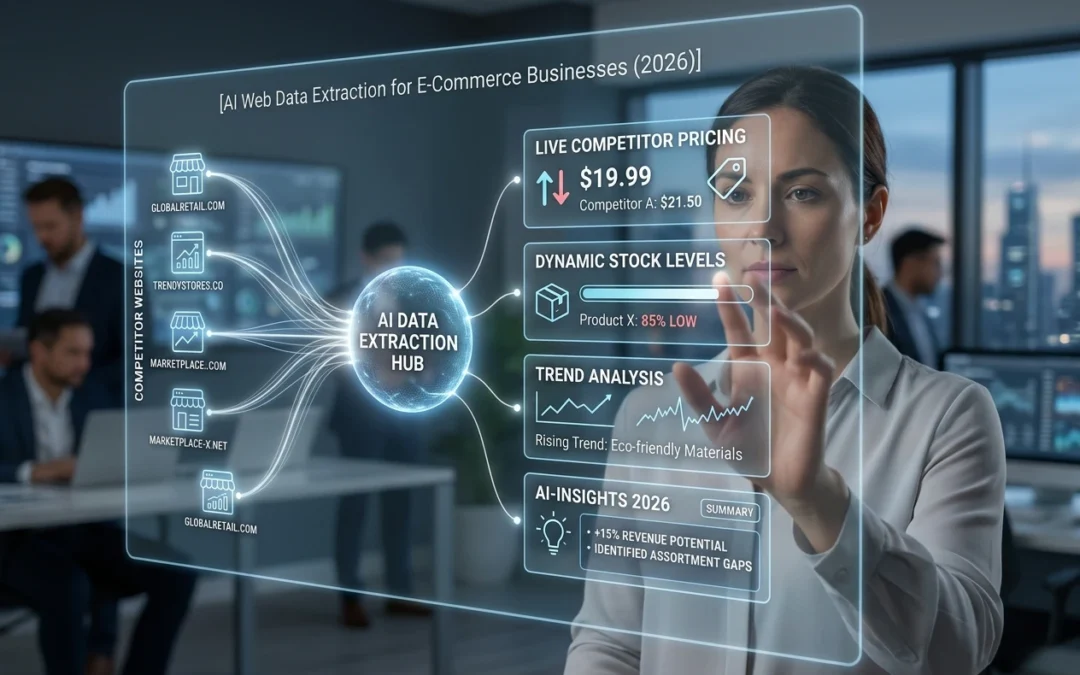
AI Data Extraction for E-Commerce Businesses (2026):
Author : Jyothish
AI Data Extraction for E-Commerce Businesses (2026)
Author : Jyothish
AIMLEAP Automation Works Startups | Digital | Innovation | Transformation
Table of Contents
- What Is Data Extraction, and Why Does It Matter for Online Retailers?
- What Kinds of Data Can You Actually Pull from Competitor and Marketplace Sites?
- How Do E-Commerce Businesses Use This Data Day to Day?
- Why Marketplace APIs Are Not Enough on Their Own
- How Does an AI-Powered Scraper Handle the Hard Stuff Modern Websites Throw at It?
- Is Scraping Competitor Websites Legal? Here Is What You Actually Need to Know
- Should You Build Your Own Scraper or Work with a Managed Service?
- Common Mistakes That Cause Extraction Projects to Fail
- How to Get Started: The Minimum Useful First Step
- Frequently Asked Questions
Every day, more than 60,000 price changes happen on Amazon alone. Shoppers compare prices across multiple stores before clicking buy, and the e-commerce brands that react fastest tend to win. The problem is that most online retailers are still relying on manual checks, outdated spreadsheets, or expensive agency reports to keep track of what competitors are doing. That approach stopped working the moment product catalogues started growing into the thousands.
This guide is for e-commerce managers, pricing analysts, and business owners who want a straight answer to a practical question: how do you collect competitor and marketplace data at scale, and what can you actually do with it once you have it? At Outsourcebigdata, we have worked with retailers across multiple markets to build data pipelines that replace guesswork with decisions based on what is actually happening right now.
We cover the full picture here: what data extraction is, what you can collect, the legal side of it, and how to decide whether to build your own system or work with a managed service. No jargon, no tool pitches. Just the real decisions you need to make.
|
$38.4B AI scraping market by 2034 |
87% Shoppers compare prices |
60k+ Daily Amazon price changes |
$8.1T E-commerce GMV by 2026 |
What Is Data Extraction, and Why Does It Matter for Online Retailers?
data extraction is the automated process of collecting structured information from websites at scale. For e-commerce businesses, this means pulling product prices, stock levels, customer reviews, and competitor catalogue data without visiting each page manually.
The simplest way to think about it: imagine hiring someone whose entire job is to visit every competitor website, note every price, check every stock status, and file a report every morning. data extraction does exactly that, but for thousands of pages at once, every hour if you need it, without any of the human error.
The older version of this technology relied on fragile scripts that broke every time a website changed its layout. A developer would write code that looked for specific HTML tags to find prices, and the moment the website updated its design, the script would stop working. Modern AI-powered extraction is different. Instead of looking for a specific CSS tag, it understands what a price looks like, what a stock status means, and can adapt when page structures change. This is the core shift that has made reliable, large-scale data collection accessible to businesses that are not running dedicated engineering teams.
At Outsourcebigdata, the difference we see most clearly in client projects is speed to insight. Teams that used to wait days for a weekly pricing report now get alerts within minutes of a competitor dropping prices on a category. That changes how fast decisions get made.
What Kinds of Data Can You Actually Pull from Competitor and Marketplace Sites?
People often assume data extraction is mainly about prices. It is far broader than that. The five types of data that consistently deliver business value for e-commerce teams are:
Product Prices, Discounts, and Promotional Activity
Real-time pricing data is the most immediate use case. You can track not just the current price but also when discounts appear, how long promotions run, whether a competitor is running a flash sale at 11pm on a Friday, and how their pricing varies by region. For retailers with thousands of overlapping SKUs, this data is the foundation of any competitive repricing strategy.
Stock Levels and Availability Signals
Knowing when a competitor runs out of stock is just as valuable as knowing their prices. When a competing brand goes out of stock on a top-selling item, the window to capture those sales is short. Automated monitoring can trigger an alert the moment availability drops so your team can act before the moment passes.
Customer Reviews and Product Ratings
Review data reveals what customers actually think, not what the marketing copy says. Patterns in one-star reviews show recurring pain points. Patterns in five-star reviews show what customers value most. Extracting and analysing this at scale gives your product team real intelligence on where competitors are falling short and where your own listings might need work.
Marketplace Listing Rankings and Catalogue Changes
On Amazon and similar platforms, where your product ranks in search results directly affects revenue. Extracting ranking data over time shows you which listing attributes drive placement, how quickly competitors respond to algorithm changes, and when their positions slip so yours can gain ground.
Shipping Costs, Lead Times, and Seller Information
Customers care about delivery, not just price. Tracking competitor fulfilment promises, shipping costs by region, and seller ratings rounds out the competitive picture in a way that price data alone cannot.
How Do E-Commerce Businesses Use This Data Day to Day?
Collecting data is not the end goal. The goal is better decisions made faster. Here is how that plays out practically across different teams.
Real-World Scenario
A retailer carries 3,000 SKUs on Amazon. A competitor drops prices on 40 of those SKUs at 9am on a Monday. Without automated monitoring, the pricing team might not see this until Wednesday. With a live data pipeline built by Outsourcebigdata, the alert fires within 15 minutes, and repricing rules automatically adjust within the hour.
Dynamic Repricing Without Losing Margin
The most common use case is repricing. But good repricing is not just chasing the lowest price. It is setting rules: when Competitor X drops below your price by more than 5% on any SKU in Category Y, adjust automatically to within 2%. When you are the only seller in stock, hold price or increase slightly. These rules require data. You cannot automate something you cannot measure.
Spotting a Competitor Going Out of Stock Before You Do
Stock monitoring is underused. When a major competitor sells out of a popular item, the demand does not disappear. It shifts. Retailers who catch this signal early and have inventory ready can absorb that demand spike before anyone else notices.
Building Product Catalogues from Multiple Supplier Sites
Retailers who source from multiple suppliers often need to aggregate data from dozens of different websites to maintain an accurate internal catalogue. Extracting product specifications, images, and pricing from supplier sites, then normalising that data into a single format, is a core use case for companies running large multi-brand stores.
Brand Compliance and Unauthorised Reseller Detection
Brands that sell through third-party retailers have a real problem with unauthorised sellers and MAP (minimum advertised price) violations. Automated monitoring across Amazon, eBay, and direct-to-consumer sites flags violations quickly enough to act on them, rather than discovering them weeks later in a quarterly audit.
Why Marketplace APIs Are Not Enough on Their Own
Every major marketplace offers an API. Amazon has the Product Advertising API. Walmart has an Open API. eBay has a developer API. These are useful, but they were built for specific purposes that do not include competitive intelligence.
What APIs Do Well
- Managing your own inventory and listings
- Building affiliate links and product feeds
- Accessing your own sales data and performance metrics
- Receiving structured data in standard formats like JSON
Where APIs Hit Walls
- Competitor data is off-limits. APIs expose your own data, not theirs.
- Quota limits restrict volume. High-frequency price monitoring across thousands of SKUs quickly exhausts API allowances.
- Missing fields. APIs often do not expose pricing history, promotional data, or review trends in the depth that business intelligence teams need.
- No cross-marketplace view. Each API covers its own platform only.The teams that get real competitive intelligence build what we call a custom data pipeline: an extraction layer that pulls directly from public-facing pages across any marketplace or competitor site, then normalises everything into a consistent, queryable format. APIs and custom pipelines are not alternatives. They serve different jobs. APIs handle authorised tasks within a single platform. Custom pipelines handle competitive intelligence across the open.
How Does an AI-Powered Scraper Handle the Hard Stuff Modern Websites Throw at It?
Anyone who has tried to build a basic scraper on a modern e-commerce site knows the frustration. A simple request to a product page often returns either nothing or a partial page that is missing the data you actually need. This is not accidental. It is how modern websites work, and it is also why many businesses have moved to managed extraction services rather than maintaining their own code.
JavaScript-Heavy Pages and Dynamic Content Loading
Most product prices, stock statuses, and personalised content are now loaded by JavaScript after the initial page loads. A simple HTTP request fetches the HTML shell, but not the data. Proper extraction requires a headless browser that actually renders the page, waits for JavaScript to finish, and then reads the fully loaded content. This adds cost and complexity compared to basic scraping, but there is no way around it for modern e-commerce sites.
CAPTCHAs, IP Blocks, and Bot Detection in 2026
Anti-bot systems have become significantly more sophisticated. IP-based blocking was just the beginning. Modern detection uses browser fingerprinting, behavioural signals (how fast a session moves through pages, mouse movement patterns), and TLS fingerprinting to identify automated traffic. Enterprise-grade extraction handles this through rotating residential proxy networks, realistic browser profiles, and rate-limiting that mimics human behaviour. A 95% or higher success rate is the benchmark that separates production-ready tools from experiments.
Keeping Up When a Site Changes Its Layout Overnight
This is where AI makes the biggest practical difference. Traditional scrapers relied on hard-coded selectors: find the element with class ‘product-price’ and read its value. When a site updates, that class name changes, and the scraper returns nothing. AI-based extraction understands that a price is a number near a currency symbol on a product page, regardless of what class name the developer chose. It adapts to layout changes without requiring manual updates to the extraction logic. For production pipelines tracking hundreds of sites, this resilience is not optional.
Is Scraping Competitor Websites Legal? Here Is What You Actually Need to Know
Scraping publicly available data such as product prices and stock levels is generally considered lawful. The key distinction is between public data (pricing, reviews, product specs) and personal data (names, emails, user profiles). Public commercial data has held up consistently in court rulings. Personal data is subject to GDPR and CCPA regardless of whether it appears on a public page.
The legal picture around scraping has clarified considerably since 2020. The hiQ v. LinkedIn case, which concluded in the US court system, established that accessing publicly viewable data does not automatically constitute unauthorised access under the Computer Fraud and Abuse Act. For e-commerce businesses focused on competitor pricing, product data, and marketplace intelligence, this is the relevant precedent.
What GDPR and CCPA Mean for Product and Pricing Data
GDPR and CCPA are genuinely important for scraping, but they apply specifically to personal data: names, emails, IP addresses, user profiles. Product prices, stock levels, and public reviews that do not contain identifiable user information are generally outside the scope of these regulations. Where they become relevant is if your pipeline accidentally collects reviewer names, seller contact details, or any field that could identify an individual. A well-designed pipeline filters those fields out before storage.
Why robots.txt Matters More Than It Used to
The robots.txt file on a website tells automated crawlers which areas the site owner prefers not to be accessed. In 2026 this is treated more seriously than it was five years ago. Regulators in Europe and courts in the US have increasingly treated robots.txt violations as evidence of bad faith. Practically, compliant extraction services build robots.txt checking into the crawl logic automatically. If you are building your own system, this should be a non-negotiable step.
The practical advice: focus extraction on public pricing, product, and catalogue data. Filter out anything that could identify an individual. Respect robots.txt. Keep audit logs. And consult a legal adviser before scaling into new markets, particularly EU markets where GDPR enforcement is active.
Should You Build Your Own Scraper or Work with a Managed Service?
This is the question we get most often at Outsourcebigdata. The honest answer depends on two things: the scale of what you need, and whether your internal team has the capacity to maintain a production system over time.
When a No-Code Tool Is Enough
If you are tracking fewer than 1,000 SKUs across a handful of competitor sites that use standard HTML page structures, a no-code tool like Browse AI, Thunderbit, or a similar platform is often the most practical starting point. These tools are fast to set up, do not require developer time, and cost a fraction of a custom solution. You can validate whether competitor price data actually changes your decisions before committing to a larger infrastructure.
When You Need a Custom Pipeline
Volume changes the equation fast. When you need to monitor 50,000+ SKUs daily across sites that use heavy JavaScript, personalised content, or aggressive anti-bot measures, no-code tools hit their ceiling. The failure modes become expensive: gaps in coverage, stale data, and silent failures where the scraper runs but returns empty fields. At that scale, a managed data extraction service or a properly engineered custom pipeline is the more reliable and, often, more cost-effective choice when you factor in developer time, proxy costs, and maintenance.
True Cost of Ownership: Build vs. Buy
|
Factor |
Build In-House |
Managed Service (Outsourcebigdata) |
|
Setup time |
4-12 weeks |
1-2 weeks |
|
Ongoing maintenance |
Weekly developer hours |
Handled by provider |
|
Site change handling |
Manual updates |
Automatic adaptation |
|
GDPR/legal compliance |
Your responsibility |
Compliance built-in |
|
Scaling cost |
Infrastructure + dev time |
Volume-based pricing |
|
Best for |
< 500 SKUs, simple sites |
> 5,000 SKUs, complex sites |
Common Mistakes That Cause Extraction Projects to Fail
Most failed data extraction projects do not fail because of technical problems. They fail because of planning problems. These are the patterns we see most often working with e-commerce teams.
- Collecting data before defining the decision it will inform. ‘Get all competitor prices’ is not a specification. ‘Alert me when any competitor undercuts us by more than 5% on our top 200 SKUs’ is. The second version is buildable. The first generates noise.
- Starting too broad. Begin with your top 3 competitors and 100 SKUs. Get that working reliably and prove the business impact before expanding to 12 competitors and 8,000 SKUs.
- Treating scraped data as clean without a validation step. A raw price string like ‘$1,299.00’ is not the same as a normalised numeric field. One misformatted page can corrupt a whole dataset if you are not building validation into the pipeline.
- Ignoring site structure changes until the pipeline breaks silently. The worst scraping failures are the ones you do not notice: the scraper runs, returns no errors, but the data is empty or wrong because the site changed. Production pipelines need monitoring and alerting on data quality, not just job completion.
- Underestimating maintenance. A scraper is not a set-and-forget tool. Sites change. Anti-bot measures update. New product categories require new extraction logic. Budget for ongoing maintenance, or choose a managed service that handles it for you.
How to Get Started: The Minimum Useful First Step
The most common reason teams delay starting is that they want a complete solution before running a single test. That is backwards. Start small, prove value, then scale.
A Practical First Test in Four Steps
- Choose your top 3 competitors and your best-selling 100 SKUs. These are the items where pricing decisions have the most direct revenue impact.
- Define one clear business question. For example: how often do these competitors change prices, and by how much? This shapes what data you need and how frequently.
- Pick a tool matched to your current scale. Under 500 SKUs and standard sites: start with a no-code tool. Over that or complex targets: talk to a managed service provider like Outsourcebigdata.
- Measure margin impact at 30 days. Did faster pricing data change any decisions? Did those decisions produce better outcomes? This is the business case for investing in a more complete pipeline.Working with Outsourcebigdata At Outsourcebigdata, we specialise in managed e-commerce data extraction for businesses at every stage. Whether you need a one-time competitive intelligence pull or a daily pipeline covering millions of SKUs, we handle the infrastructure, compliance, and data quality so your team focuses on decisions rather than data collection. Reach out through outsourcebigdata.com to discuss your specific use case.
Frequently Asked Questions
These questions come directly from Reddit threads (r/ecommerce, r/datascience), Google People Also Ask results, and common queries the Outsourcebigdata team receives from new clients.
Q1: How does AI data extraction actually work — is it the same as scraping?
scraping and AI data extraction are related but not identical. Traditional scraping uses hard-coded rules to find data in specific HTML locations. AI-based extraction uses machine learning models to understand what data looks like contextually, so it can adapt when a website changes its structure. For e-commerce purposes, AI extraction is significantly more reliable at scale because it does not break every time a site updates its design.
Q2: Is it legal to scrape prices from competitor websites?
Scraping publicly visible pricing and product data has generally been upheld as lawful, particularly following the hiQ v. LinkedIn case in the US. The key boundaries: do not bypass login walls, do not collect personal data without a lawful basis, respect robots.txt directives, and do not overload servers with excessive requests. For businesses operating in the EU, any scraping operation should document its data minimisation practices and exclude personally identifiable information. This is not legal advice; consult a solicitor for your specific situation.
Q3: How often does competitor pricing data need to be updated?
It depends on your category. In consumer electronics and fashion, prices can change multiple times per day around promotional events. For more stable categories like furniture or B2B supply, daily or twice-daily updates are often sufficient. The right frequency is the one that lets you act on changes before the commercial opportunity passes. For most mid-size retailers, hourly monitoring on top SKUs and daily monitoring on the broader catalogue is a practical starting point.
Q4: Can you scrape Amazon product listings without getting blocked?
Amazon has some of the most sophisticated bot detection in e-commerce. Basic scrapers get blocked quickly. Production-grade extraction for Amazon data requires rotating residential proxies, realistic browser profiles, and careful rate limiting. Many businesses find that working with a specialist provider like Outsourcebigdata is more reliable and cost-effective than building and maintaining this infrastructure in-house.
Q5: What is the difference between scraping and using the Amazon API?
The Amazon Product Advertising API gives you access to your own listings, affiliate product data, and some marketplace information within strict limits. It does not provide competitor pricing data, pricing history, review trends, or catalogue-level intelligence across third-party sellers. Custom extraction fills those gaps. Most e-commerce intelligence operations use both: the API for authorised, structured access to their own account data, and extraction for competitive intelligence on the open marketplace.
Q6: How do I stop my scraper from getting blocked on e-commerce sites in 2026?
The most effective approaches are: using residential proxy rotation (datacenter IPs get blocked fast), implementing realistic delays between requests, rendering JavaScript with a headless browser rather than making raw HTTP requests, and rotating user agent strings. Beyond these basics, modern bot detection looks at behavioural patterns across a whole session. Enterprise extraction providers invest heavily in keeping their infrastructure ahead of detection systems. If your scraper is getting blocked consistently, it is usually a signal that the task requires managed infrastructure rather than a DIY solution.
Q7: Does GDPR apply if I only collect product prices, not personal information?
Product prices, stock levels, and product descriptions are not personal data under GDPR and generally fall outside its scope. Where GDPR becomes relevant is if your pipeline accidentally captures data that could identify an individual: reviewer names and usernames, seller contact details, or anything linked to a specific person. A well-designed extraction pipeline filters these fields before storage. If you are extracting from sites serving EU consumers, document your data minimisation approach and keep audit logs.
Q8: What data should I be collecting if I want to beat competitors on Amazon?
Focus on four data points to start: current price and price history for your top competing ASINs, buy box ownership (who holds the buy box and at what price), stock status for your key competitors, and review velocity (how quickly new reviews are appearing on competing products, which signals sales momentum). From these four signals, most pricing and positioning decisions on Amazon can be significantly improved.
Get Notified !
Receive email each time we publish something new: